Energy
EDB Eyes $400m for Uzbekistan Hydropower Projects

November 26, 2026

3
Min
The Eurasian Development Bank (EDB) and JSC Uzbekhydroenergo, Uzbekistan's hydropower company, have signed a memorandum of understanding to build a portfolio of hydropower projects with about $400 million of potential EDB financing, the bank said on 26 November. The memorandum was signed during a working visit by an EDB delegation to Uzbekistan.
According to the EDB, the projects under consideration could have a combined capacity of up to 500 MW. The list is preliminary and may change, and financing decisions depend on both parties' internal procedures. The two sides also discussed setting up a joint working group to take the projects forward.
"At the initial stage, we are considering building a portfolio of investment projects with approximately US $400 million in EDB financing," said Nikolai Podguzov, Chairman of the EDB Management Board, according to the bank. Islam Abdurakhmonov, Chairman of the Management Board of Uzbekhydroenergo, said the company was "interested in developing long-term cooperation with the EDB".
The priority list covers new plants and cascades as well as the modernisation of existing stations and their equipment, Trend reported. Neither the bank nor the company has named individual sites or published a timetable.
The bank noted that in neighbouring Kyrgyzstan it provided $44 million for the 100 MW Kulanak hydropower plant.
The memorandum also fits a wider plan. When it opened a representative office in Tashkent in May, the EDB said it planned to invest up to $1.5 billion in Uzbekistan by 2031. The bank's total portfolio stood at $22.1 billion across 348 projects at the end of June 2026, according to its latest release. A $400 million hydropower pipeline would on its own account for more than a quarter of the Uzbek target.
Hydropower matters to Uzbekistan for a reason beyond clean generation. The country is adding solar and wind capacity and needs flexible plants to balance that output. Modernised hydropower stations can ramp up and down quickly, which makes them useful partners for intermittent renewables. Caucasus Business Journal has covered recent financing for that build-out, including a $300 million New Development Bank loan for low-carbon energy and a 500 MW solar term sheet with Oman's Voltamp.
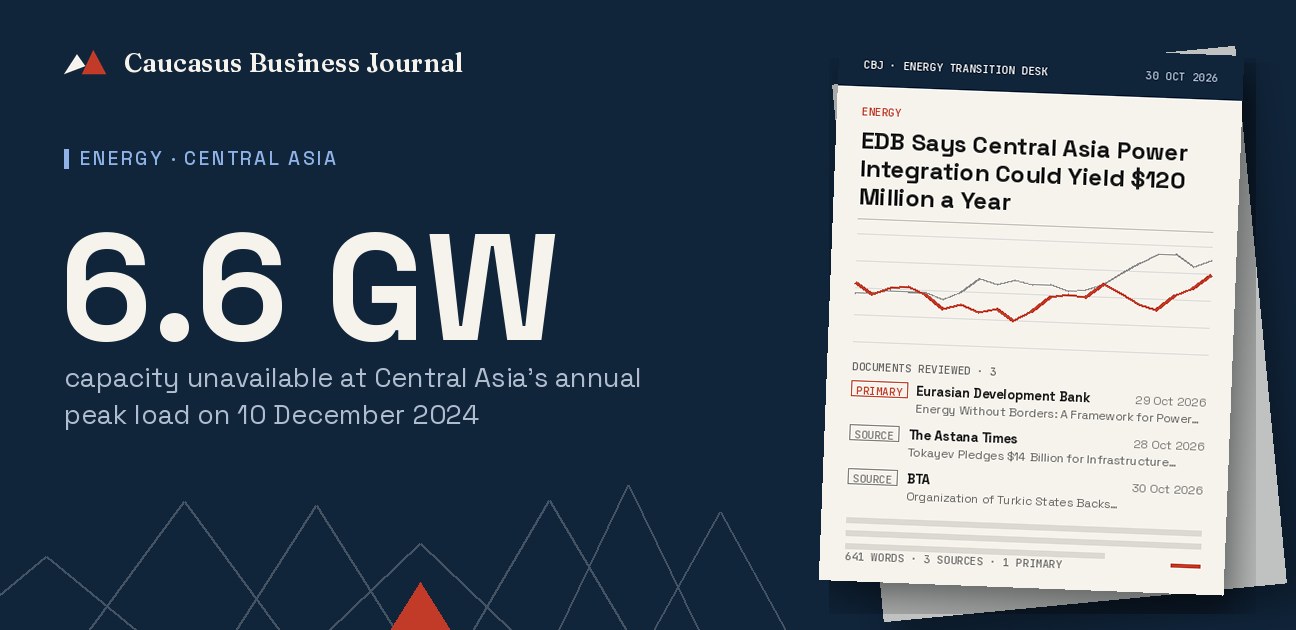
The EDB has also argued that Central Asia loses value by not sharing power across borders. In an October study, it estimated that better power connectivity could yield about $120 million a year. Hydropower in the upstream states is central to that case.
Caution is warranted. A memorandum of understanding is not a loan agreement. The figures are indicative, the project list is not final, and approval will depend on feasibility work, pricing and the state of Uzbekhydroenergo's finances.
First, whether the joint working group publishes a named list of plants and cascades, with capacities and costs. Second, when the first loan agreements are signed, and in which currency. Third, how much of the 500 MW comes from new construction rather than upgrades of existing stations, which would show whether the deal adds capacity or mainly extends the life of older assets.
Sources: Eurasian Development Bank, 26 November 2026; Eurasian Development Bank, 18 May 2026; Trend, 26 November 2026.
Image: Caucasus Business Journal archive graphic, via caucasusbusinessjournal.com