Energy
EDB Says Central Asia Power Integration Could Yield $120 Million a Year

October 30, 2026

4
Min
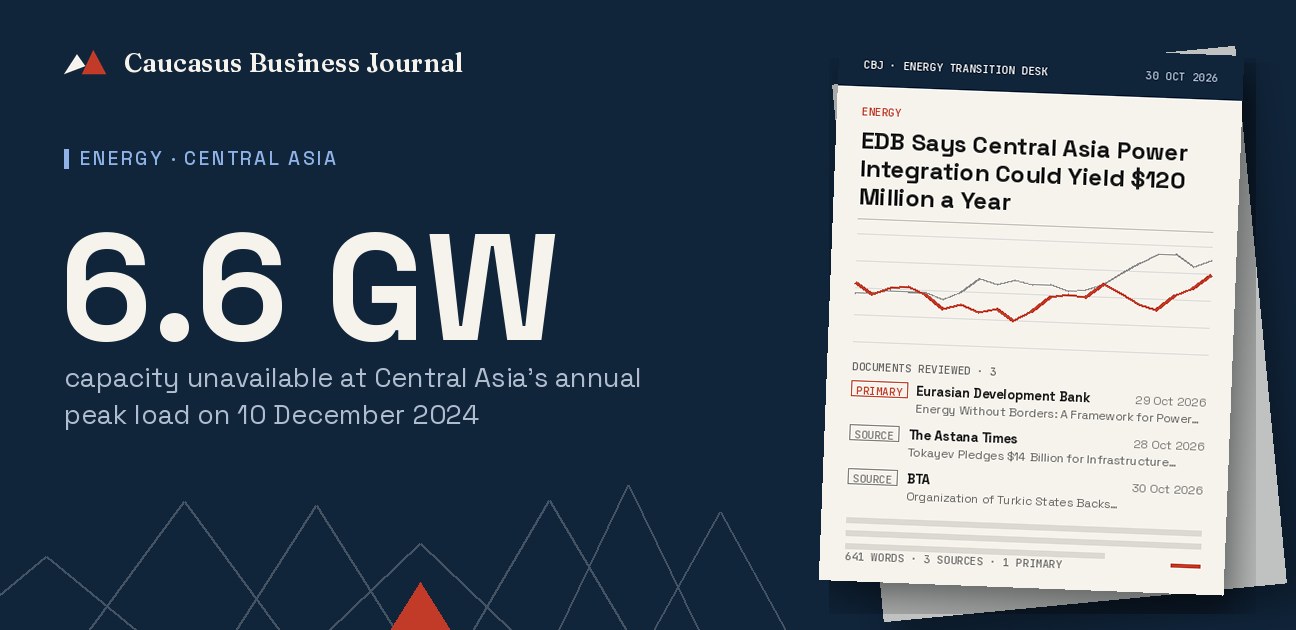
Central Asia could gain up to US$120 million a year in net economic benefits by making better use of power plants and grids it already has, the Eurasian Development Bank (EDB) said in a report published on 29 October. At the region's annual peak load on 10 December 2024, around 6.6 GW of capacity in the Central Asian Unified Power System was unavailable just when it was needed most.
The report, Energy Without Borders: A Framework for Power Connectivity in Central Asia, argues that the region can make more electricity available without new power plants, through coordinated system operation, digital monitoring and phased market development, according to the EDB's press release. The bank lists cold reserve capacity, hydrological and fuel constraints, equipment condition and network limits as the causes.
Cross-border electricity trade within the Central Asian Unified Power System totalled 12.1 billion kWh in 2024, which the EDB describes as well below the levels seen in mature regional markets. Digitalisation, accurate assessment of available transmission capacity and coordinated system operation could add up to 6 billion kWh of trade a year. Integration could bring gross benefits of up to US$640 million a year and net benefits, after costs, of up to US$120 million, which the bank presents as scenario-based estimates.

Demand is growing by up to 6% a year and could reach around 370 billion kWh by 2030, the report says, while more than 35 GW of variable generation capacity is planned by 2035. Uzbekistan alone is projected to face renewable energy curtailment of 2.1 to 3.5 billion kWh a year in 2026 to 2028. The bank also flags a political risk: gains for the region as a whole will not necessarily be shared evenly, so a project that pays overall may remain politically difficult unless countries agree in advance how to share the gains.
The EDB sets out five priorities: digital monitoring and commercial metering; calculating and publishing available transmission capacity; priority grid reinforcements ranked by measurable system-wide benefit; phased market development, from structured bilateral trade to a regional day-ahead market and then balancing and ancillary services markets; and payment for hydropower flexibility. It names Toktogul, the Naryn cascade, Nurek and the planned Rogun plant as resources for regulation, peak demand and seasonal balancing, and argues that this flexibility should be a remunerated system service governed by contracts. The report also examines southern links, including the risks and conditions around CASA-1000, as well as northern, eastern and trans-Caspian connections.
The bank published the report a day after Kazakhstan's president described his country's supply as short. In his state-of-the-nation address on 28 October, Kassym-Jomart Tokayev said annual output of 123 billion kilowatt-hours was critically insufficient, and that Kazakhstan buys electricity from neighbouring countries at high prices in winter peaks and sells it back in summer at much lower prices, The Astana Times reported. He set a target of a sustainable electricity surplus by 2029.
At their summit in Ankara on 30 October, leaders of the Organization of Turkic States welcomed progress on the Central Asia-Azerbaijan Green Energy Corridor, involving Azerbaijan, Kazakhstan and Uzbekistan, and backed the Caspian Sea-Black Sea-Europe Green Energy Corridor, BTA reported. The EDB report also examines trans-Caspian connections and the conditions under which such links can strengthen regional cooperation. CBJ has reported that the Caspian-Black Sea-Europe link is put at €22.1bn.
For developers, traders and lenders, the report points to near-term work that needs software, metering and rules more than steel: published transmission capacity, settlement rules for deviations from schedules and contracts for hydropower balancing. The EDB, headquartered in Almaty, also published research this week showing that the share of local currency in development bank financing in Eurasia rose to 30% over the last ten years.