Global
Uzbekistan Tops 2025 Investment Total in Nine Months

November 15, 2026

3
Min
Uzbekistan has already drawn more foreign money in nine months of 2026 than in the whole of 2025. The Ministry of Investment, Industry and Trade told a committee of the Legislative Chamber on 13 November that about $44.1bn of foreign investment and loans was used from January to September, 23.9% above target, according to Trend (14 November 2026).
The comparison is striking. Full-year 2025 came in at $43.1bn, up 24% on 2024, the ministry said in its January release (7 January 2026). On those figures 2026 is about 2% ahead of last year's total with a quarter still to run. The ministry also reported 106 strategic projects launched under the State Investment Program and said all 45 of its quarterly performance indicators were met.
The headline number is not fully settled. On 3 November UzDaily (3 November 2026) reported $44.3bn for the same period, citing Minister Laziz Kudratov's reply to a parliamentary inquiry. That report said 106 major projects worth $3.8bn had been commissioned and 13,800 jobs created. The $0.2bn gap may reflect rounding or revision; neither report explains it.
The nine-month reports give a single combined figure for foreign investment and loans. They do not separate foreign direct investment from borrowing, and they name no sectors or regions. That matters because the two are different things: investment brings equity and ownership risk onto a foreign balance sheet, while loans, including those guaranteed by the state, add to public or quasi-public debt.
The only split available is from last year. The ministry put 2025 foreign direct investment at $38.2bn, with a further $4.9bn from international financial institutions. On that basis roughly 89% of last year's total was direct investment, though the ministry's page does not say whether the $4.9bn was all lending.
A mid-year snapshot offers a hint at geography. In its January to July update (24 August 2026) the ministry reported $32.9bn used, 131.1% of target, of which $24.3bn, about 74%, was in the regions at 161.8% of target. Taken at face value, the $11.2bn implied for August and September, about $5.6bn a month, is faster than the roughly $4.7bn a month of the first seven months. These are this outlet's calculations from the ministry's rounded figures.
The over-delivery is partly a function of the yardstick. Using the 23.9% overshoot, the implied nine-month target is near $35.6bn, so the plan was set well below the pace the country actually reached. The same ministry's draft 2027 figure of $65bn, covered in our earlier report, would require a further step up.
Three disclosures would turn a strong headline into a usable one. First, the FDI and loan split for 2026, and how much of the loan component carries a state guarantee. Second, a sector breakdown, since commissioning of 106 projects says little about energy, mining or manufacturing weights. Third, a reconciliation of the $44.1bn and $44.3bn figures when the statistics agency publishes its own data. Lawmakers have also pressed for projects to match regional potential, and a new law on special economic zones is being drafted.
Sources: Trend, 14 November 2026; UzDaily, 3 November 2026; Ministry of Investment, Industry and Trade, 7 January 2026; Ministry of Investment, Industry and Trade, 24 August 2026.
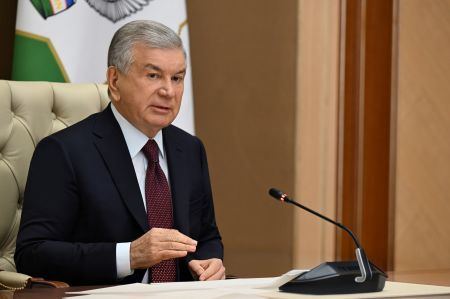
Image: Press Service of the President of Uzbekistan, via president.uz