Business
Georgian Railway Seeks Consultant for Anaklia Port Rail Link

October 25, 2026

4
Min
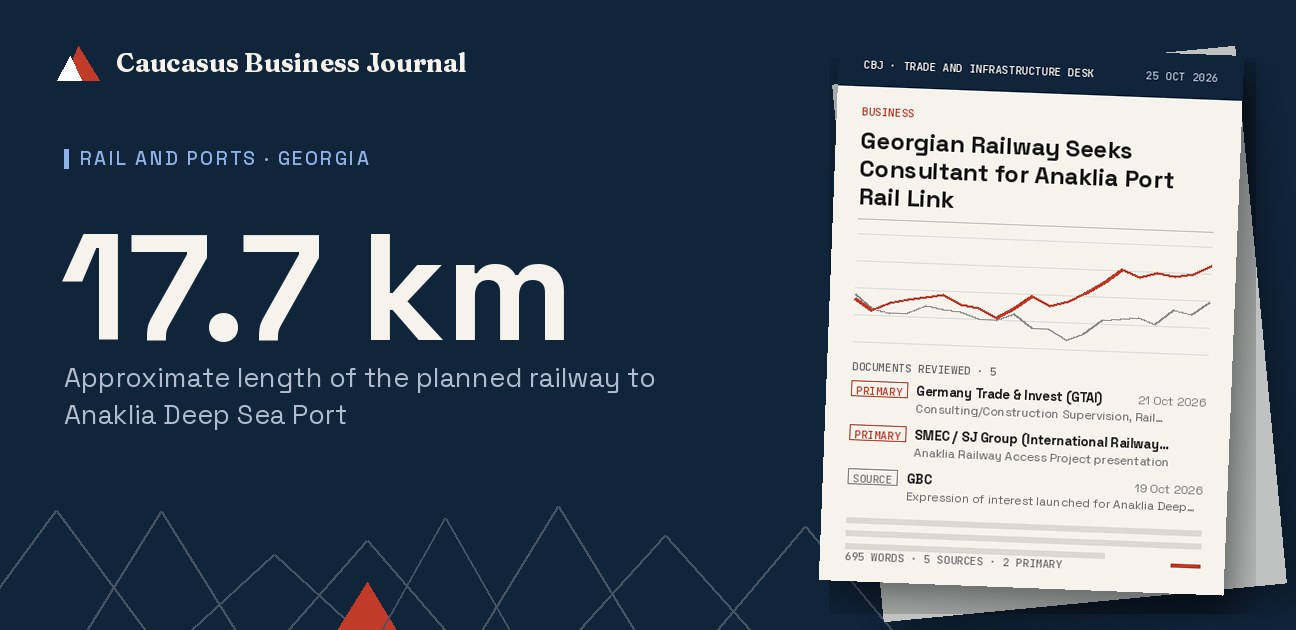
Georgian Railway is seeking a consultancy firm to supervise the design and construction of a railway of about 17.7 km to the Anaklia Deep Sea Port. Expressions of interest are due on 17 November 2026, according to the World Bank-financed notice listed by Germany Trade & Invest (GTAI) on 21 October.
The assignment is titled "Supervision of design and build of a railway and related infrastructure connecting to the Anaklia Deep-Sea Port" and sits under the Trans-Caspian Transport Corridor, Georgia Accessibility and Transport Enhancement Project, known as TC-GATE, with reference numbers P513957 and OP00475520. Business news site GBC reported the call on 19 October, quoting a Georgian Railway statement that the line would be about 17.74 km long, with a new station, a railway junction and other related infrastructure. Firms can apply until 17:00 on 17 November.

The works to be supervised include electrification, overpasses and underpasses, drainage, a new Anaklia station, the Khamiskuri railway junction and modernisation of Khobi station, among others. The consultant will also support the client with contract and project management. The title indicates the works will be procured as design and build, with the consultant overseeing both design and construction.
Technical choices are set out in a presentation by SMEC / SJ Group, whose objectives include preparing the detailed design for an 18 km electrified railway line and ensuring integration with the Georgian rail network, with deliverables such as design packages, specifications and tender documents from teams in Astana and Tbilisi. It described a single electrified track with double-tracking potential, 1520 mm gauge, R65 rails on reinforced concrete sleepers, a maximum freight speed of 80 km/h and a 3.3 kV DC catenary system. Three route alternatives were evaluated before an alignment was selected on terrain, cost and freight forecast.
Elevated embankments, resilient bridges and culverts address seismic and flood risks on the Kolkheti Plain. The presentation listed a draft environmental impact assessment and resettlement action plan, with environmental and social studies aligned with EBRD standards, and said implementation was divided into three lots. CBJ reported on 10 October that Prime Minister Irakli Kobakhidze put the cost of the link at about $200 million.
Economy and Sustainable Development Minister Mariam Kvrivishvili told the International Maritime Forum in Batumi in September that the state would invest $700 million in the port, and $1.1 billion including private investment, Georgia Today reported, citing Mtavari. Under the landlord model the government keeps full ownership of the core infrastructure. The port will begin operations in 2029 with an initial annual capacity of at least 600,000 TEU and about 10 million tons of dry cargo, according to the report.
Dredging began in August and intensified in September, with two Jan De Nul vessels working in the port's maritime area, according to an analysis published by Georgia Today on 10 October. It said Georgian Railway had completed the design of the rail connection, with a construction tender expected by the end of October 2026, and that the World Bank approved $372 million for TC-GATE in June, aimed at railway freight capacity, roads and transport sector reforms. Georgia's parliament ratified the loan agreement on 15 September, it added.
Rail access will shape how much of Anaklia's planned container and dry cargo capacity can move inland once the port opens. For engineering and supervision firms, the notice sets out the works package: a new Anaklia station, the Khamiskuri junction and an upgraded Khobi station. Logistics operators comparing Anaklia with Poti and Batumi will watch the timing of the works award as a guide to whether rail service can be ready when the port opens in 2029. Georgia aims to double port and rail capacity, its economy minister told a China forum, CBJ reported on 22 September.