Global
Four EAEU States Project 55.6% Trade Fall if Armenia Is Suspended

October 25, 2026

5
Min
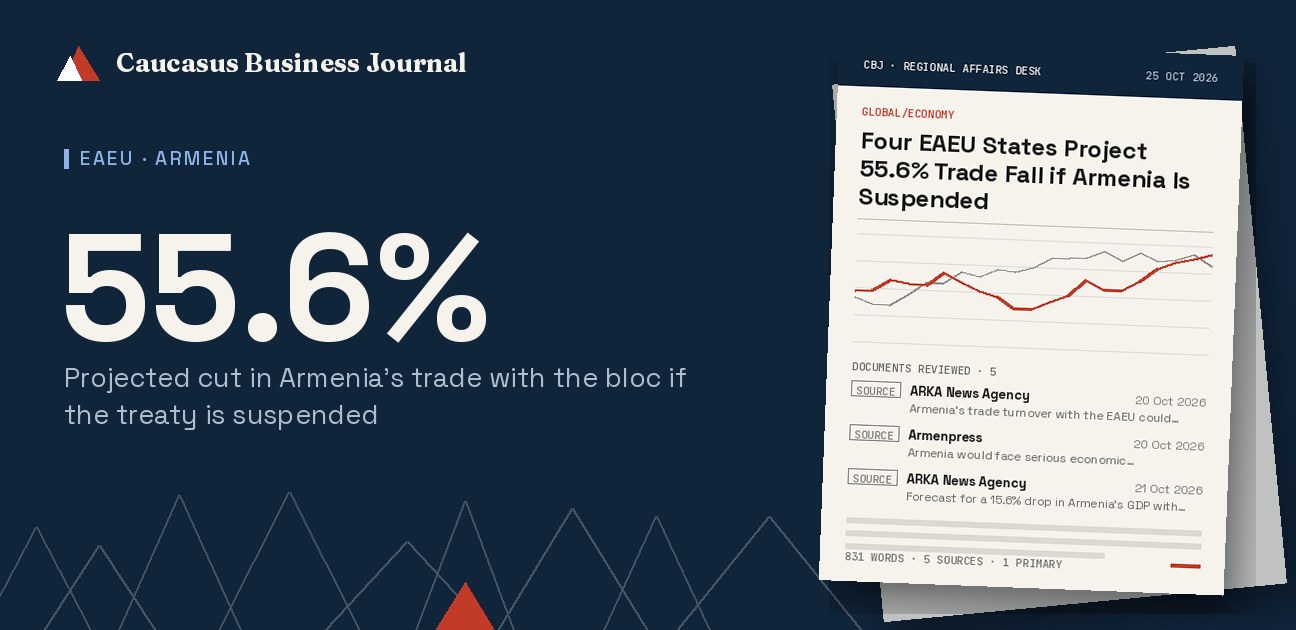
Four Eurasian Economic Union (EAEU) members, Russia, Belarus, Kazakhstan and Kyrgyzstan, estimated that suspending the union treaty for Armenia would cut Armenia's trade with the bloc by 55.6%, from $7,990.6 million to $3,550.9 million, in a report released on 20 October and published on the Russian government's website, ARKA reported. Prime Minister Nikol Pashinyan replied on 22 October that member states had no right to expel Armenia.
The report was prepared by the four countries' members of the Eurasian Intergovernmental Council under a joint statement by their presidents dated 29 May 2026, for the December meeting of the Supreme Eurasian Economic Council. An appeal to that council, with the report attached, was sent to the Eurasian Economic Commission on 20 October for transmission to the council's members, the leaders of the member states, Armenpress reported.
The authors considered a temporary suspension of the 29 May 2014 EAEU Treaty for Armenia, its businesses and its citizens. They said the treaty did not explicitly provide a mechanism for unilateral suspension, pointed to the 1969 Vienna Convention on the Law of Treaties and argued that Armenia's actions ran counter to Article 3 of the treaty. The suspension could stay in force until Armenia holds a referendum on remaining in the EAEU or joining the European Union.
Against its baseline, the report projected a 15.6% contraction in Armenia's GDP, inflation 14.9 percentage points higher and consumption 14.6% lower, with customs controls and duties, full sanitary controls and taxation of goods restored. The gas import price would rise from $177.50 to $300 per thousand cubic metres, a 69% increase the report called indicative, lifting the cost of gas imports from $389 million to $657.5 million.
Exports to EAEU states would fall 65.8% to $1,084.3 million and imports from them 48.8% to $2,466.6 million. Re-export and logistics-linked exports would drop 91.6%, from $1,598.2 million to $135 million, and traditional exports 39.6%, with alcoholic beverages down 50.1% and food and agricultural products down 39.9%. The union's free trade agreements with third countries would cease to apply to Armenia. According to the report, the EAEU accounts for 37.8% of Armenia's total trade turnover.
The employment regime set by the EAEU Treaty would end for Armenians, bringing back work patent or permit requirements, and remittances from EAEU countries would fall from $3.95 billion to $1.85 billion, according to the report's figures as set out by ARKA.
"It is obvious that member states have no right to expel a member state from the organization," Pashinyan said on 22 October, the day his cabinet approved a new employment programme. "There is no economic component here; we are dealing with a political component," he added, Armenpress reported. On the report's numbers he said: "As for those data and forecasts, we will live and see." The government said it had no intention of leaving the bloc and that its EU integration efforts in no way undermined its EAEU membership.
Economy Minister Gevorg Papoyan has called the estimates exaggerated "by about 50%" and put the direct negative effect of an exit at about 0.65% of the economy, as CBJ reported.
Tigran Jrbashyan, Head of the Management Consulting Service at Ameria, said the volume of re-exports was not equivalent to their contribution to GDP, that the projected 54.6% fall in exports to non-EAEU countries exceeded the losses forecast for the EAEU market itself, and that the remittance forecast rested on data from 2010 to 2014. "I do not deny that there are serious economic risks associated with changing relations with the EAEU," he said.
In the EU regulation on temporary trade-liberalisation measures for Armenian products, EU legislators wrote: "Since May 2026, the Russian Federation has introduced large-scale trade measures affecting imports of, and transit for," key Armenian exports including alcoholic beverages, mineral water, fruits and vegetables (agreed text). Armstat data cited by ARKA showed Armenia's trade with the EAEU fell 17.2% to $3.85 billion in January to August 2026, while total trade rose 3.2% to $13.27 billion.
For companies the report is a stress test, not a decision, but it shows where exposure sits: re-export and logistics businesses first, then producers of alcoholic beverages and food selling into EAEU markets, employers and households that rely on the EAEU employment regime and remittances, and users of imported gas. The legal route is untested, since the authors said the treaty had no explicit suspension mechanism, and the projections are deviations from a baseline in a year for which the World Bank forecast 5.6% growth. Firms with EAEU revenue can model a suspension case covering customs costs, certification, gas prices and staffing.