Business
EBRD Intends to Raise Caspian Shipping Investment on Middle Corridor

October 25, 2026

4
Min
The European Bank for Reconstruction and Development (EBRD) intends to increase its investment in maritime transport on the Middle Corridor, Nataly Mouravidze, head of the EBRD office in Azerbaijan, said at the EU-Azerbaijan Business Forum in Baku, Report.az reported on 21 October. At the same forum, a freight forwarders' representative said Kazakhstan's Aktau port had operated on only 10 of 60 days last December and January.
"We intend to increase investments in the maritime transport sector in the future as it reaches certain milestones," Mouravidze said. She listed EBRD financing for dry cargo vessels for Azerbaijan Caspian Shipping Company (ASCO), the expansion of Aktau port, an agreement on a bond placement by Kazakhstan Temir Zholy (KTZ) and a logistics hub and warehouse project in the Alat Free Economic Zone. The report gave no amounts.
Elmir Poladov, deputy chairman of the Azerbaijan Freight Forwarders Association, told the forum that weather, limited ferry and Ro-Ro capacity and the lack of a consistent departure schedule create uncertainty on the Caspian crossing. Forwarders can promise rail delivery to the day, he said, but sea transit can only be estimated to within a week.
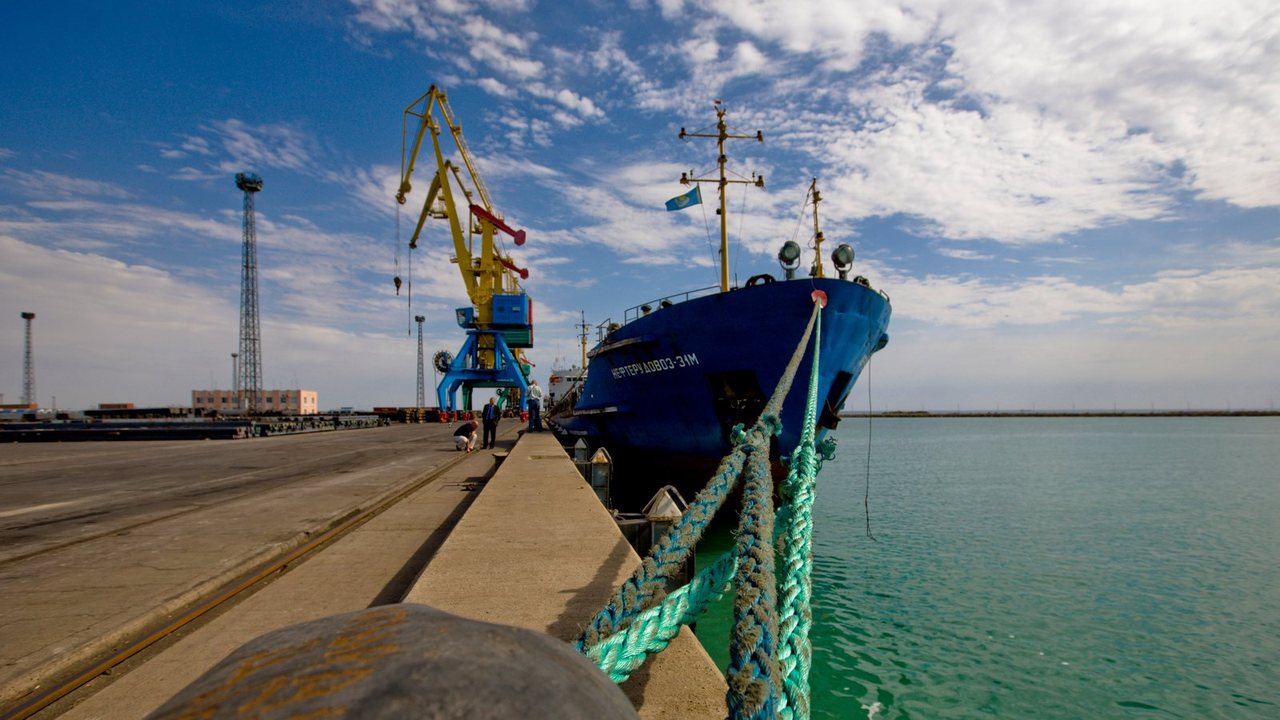
Kazakh operators describe the same constraint. Adverse weather can restrict operations at Kazakhstan's ports for up to 75 days a year, Yerkin Nygmetov, chief executive of KTZ Express Shipping, told the New Silk Way forum in Astana on 15 to 16 October, The Times of Central Asia reported. Falling Caspian Sea levels add to the pressure: in September, an ASCO representative said one of its ferries could carry only about 80% of its full load from Kazakhstan.
Both countries are adding tonnage. ASCO's transport fleet numbers 56 vessels, including 23 tankers, 13 ferries, 16 dry cargo ships, two Ro-Ro and two Ro-Pax vessels, Kazinform reported on 22 October. Citing ASCO data, it said the company's ships carried about 9.086 million tonnes in 2025, up 5.38%, and 22,030 TEU of containers, up 203% on 2024.
Baku Shipyard is building four vessels: two 780 TEU container ships for Kazakhstan's Kazmortransflot together with AD Ports Group of the United Arab Emirates, and two multipurpose dry cargo ships for KTZ Express Shipping, an order Kazakhstan's Samruk-Kazyna fund announced on 15 October. The container ships, each more than twice the 350 TEU of existing ships in similar service, are scheduled for completion by the end of 2027. KTZ Express Shipping plans to acquire five container vessels in 2026, has ordered six more multipurpose dry cargo and container ships from yards in China and Azerbaijan, and aims for a fleet of 13 vessels with 96,000 tonnes of deadweight by 2028.
Kazakhstan began dredging at Aktau in 2026 to remove about 1.3 million cubic metres of soil and deepen the port's waters to 6 to 7 metres, Kazinform said. Kazakhstan's government said in July, when the prime ministers of Kazakhstan and Uzbekistan visited the port, that the project was planned for completion by the end of 2026 and would allow fully loaded vessels to enter safely. The first stage of an Aktau container hub, with capacity of 140,000 TEU a year, has been put into operation, and a second stage in 2027 to 2028 would raise it to 240,000 TEU, the government said in the same release. Across the sea, the Baku port targets container capacity of 260,000 TEU in the second half of 2027.
For companies routing cargo between China, Central Asia and Europe through Azerbaijan, the sea crossing is where delivery dates slip. China to Georgia transit times stretched to 40 to 45 days as demand outpaced capacity, with Aktau among the bottlenecks, CBJ reported in September. Poladov's December and January example points to the winter months as the main risk for shipments booked around the year end, which argues for wider delivery windows or buffer stock on time-sensitive cargo. The World Bank forecast trans-Caspian cargo to grow 3.6-fold to 32.1 million tonnes by 2040, CBJ reported. New ships due from 2027 and the EBRD's interest should add capacity, but Mouravidze tied future investment to milestones, and falling water levels limit how much each vessel can carry. For investors, the EBRD's existing deals, from ASCO's dry cargo vessels to Aktau port, show where development lenders are putting money on the route.