Business
Georgia Pitches $7bn Transport Plan at COP31 Talks

November 11, 2026

3
Min
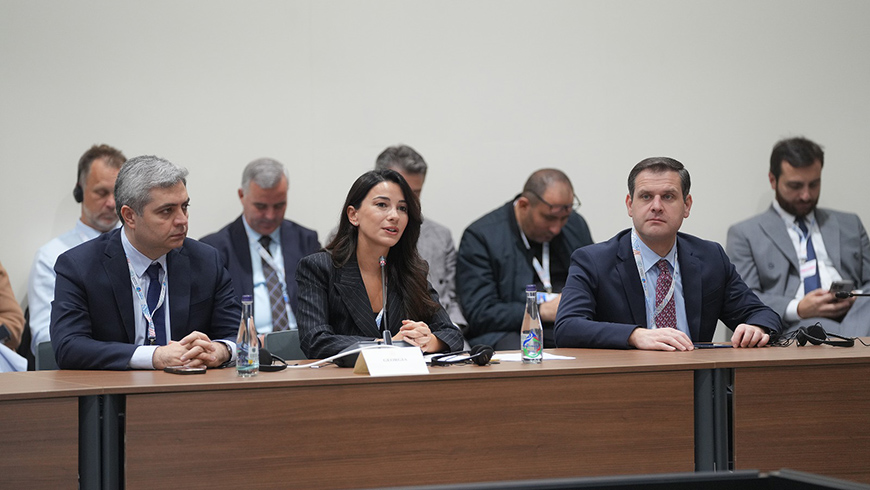
Georgia's Deputy Prime Minister and Minister of Economy and Sustainable Development, Mariam Kvrivishvili, set out the country's transport investment plans on 10 November at a ministerial meeting on the Global Green Freight Corridors Initiative in Antalya, held within the COP31 climate conference, the ministry said.
She told the round table that Georgia's long-term transport strategy envisages about $7 billion in investment by 2032, covering railway modernisation, port and road infrastructure and multimodal connections, and that the Anaklia Deep Sea Port is planned to become operational by 2029.
According to the Ministry of Economy's account of the meeting, the initiative was launched by Turkey with the UN Economic Commission for Europe and the UN Economic and Social Commission for Asia and the Pacific. About 10 countries were represented at ministerial level, including Bulgaria, Czechia, Azerbaijan and the Netherlands.
The $7 billion figure is not new. Prime Minister Irakli Kobakhidze cited it on 9 October, when he also said the modernisation of the main railway line, finished at the end of 2025, had doubled its capacity.
Kvrivishvili added operational numbers. Since the move to a maritime single window in 2024, the time for maritime administrative procedures has fallen from about 24 hours to about one hour, and rail border-crossing procedures have become about 7.5 times faster. She said the railway network is fully electrified, that modernisation halved transit times, and that the Baku-Tbilisi-Kars line began operating at full capacity in June 2026.
Diplomacy a few days earlier showed who the corridor is meant to serve. On 5 November, Kvrivishvili met Chinese Vice Premier Ding Xuexiang. The ministry reported that trade between Georgia and China grew 21% in 2025 and 41% in January to September 2026. The sides discussed the Middle Corridor, the Anaklia port, railway modernisation and direct flights, and noted a joint working group on bilateral trade that has already held its first session.
The message to both audiences is consistent: Georgia wants to be priced as a fast, low-emission link between Asia and Europe. Climate framing helps, because green freight initiatives tend to attract the development finance that large port and rail projects need. Kvrivishvili said Georgia welcomes closer cooperation with international financial institutions, development partners and the private sector, which is an open invitation for co-financing rather than a funded commitment.
The emissions targets give the investment a measurable shape. Under its updated Nationally Determined Contribution, Georgia aims to cut transport sector greenhouse gas emissions by 20% by 2030 and 25% by 2035, against a projection without additional measures. The ministry did not say how much of the $7 billion is already financed, nor how it divides between rail, ports and roads.
Three markers will show whether the pitch converts into business: the financing structure for Anaklia and the 2029 opening date, any follow-up from the China working group on Georgian exports, and whether the new freight initiative produces funding windows that Georgian projects can use. Our earlier report on the Anaklia port rail link consultancy tender covers one of those workstreams.
Sources: Ministry of Economy and Sustainable Development of Georgia, 10 November 2026; Ministry of Economy and Sustainable Development of Georgia, 5 November 2026; Georgia Today, 9 October 2026.
Image: Ministry of Economy and Sustainable Development of Georgia, via economy.ge