Finance
EDB: IFI Private-Sector Financing Fell 36% in Q3

November 11, 2026

3
Min
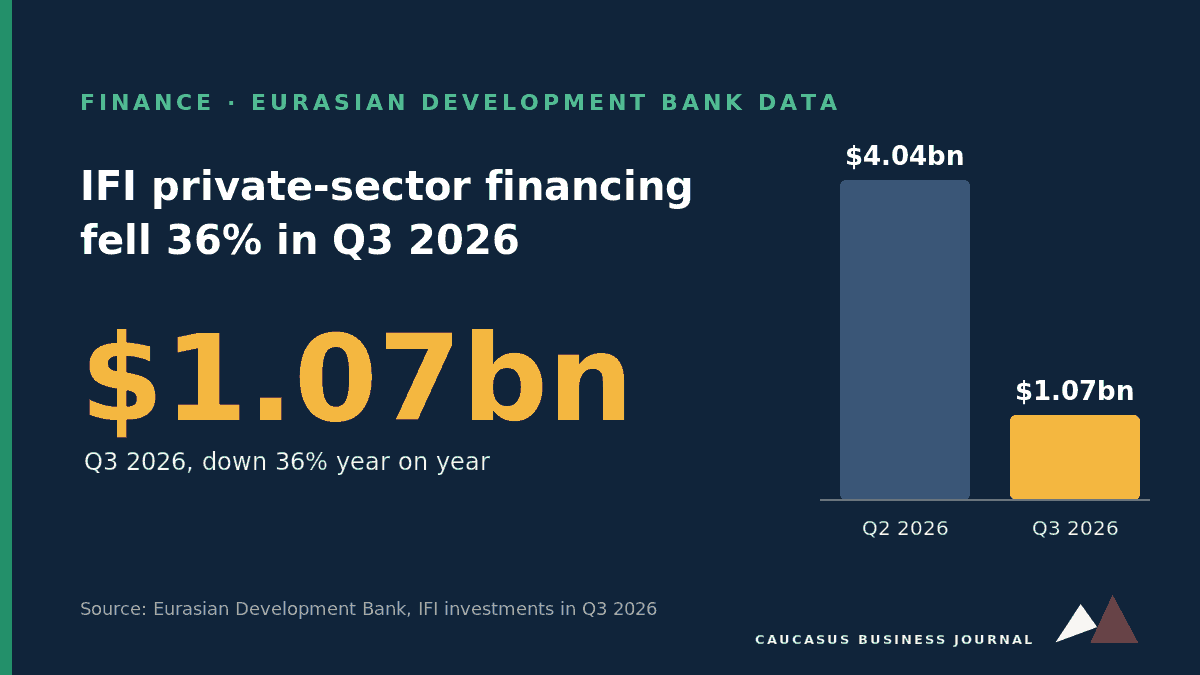
Non-sovereign financing by international financial institutions (IFIs) in the countries tracked by the Eurasian Development Bank (EDB) fell to $1.07bn in the third quarter of 2026, down 36% year on year and 74% below the $4.04bn recorded in the second quarter, the EDB said in an analytical brief published on 5 November.
The quarterly fall comes after a strong first half. Over January to September, non-sovereign IFI financing reached $6.79bn, up 50% on a year earlier, with the second quarter accounting for about 60% of the total.
The EDB said the quarterly decline was driven mainly by fewer large transactions. Deals of $100m or more totalled $981m in the third quarter of 2025. In the third quarter of 2026 there was only one: a $190m guarantee from the Multilateral Investment Guarantee Agency (MIGA) covering KfW's financing to the Development Bank of Kazakhstan for renewable energy. Transactions under $100m rose 29% to $882m, from $685m.
Guarantees are a fast-growing tool. They made up 21.9% of IFI financing in January to September 2026, against 4.1% a year earlier, with volume rising from $0.2bn to $1.5bn. MIGA, the EDB, the EBRD and Proparco were the main providers.
Third-quarter financing in Kazakhstan rose by $207m, or 76%, year on year, and in Azerbaijan it rose 4.4 times, by $143m. Uzbekistan, Armenia and Georgia together saw a fall of about $1bn. In Azerbaijan, the $185m total came from the EBRD, AIIB, OPEC Fund and the Black Sea Trade and Development Bank. It included an EBRD portfolio guarantee of up to €75m ($86m) for AccessBank's SME loans and a $45m AIIB loan for a Caspian Sea desalination plant, co-financed by a $40m OPEC Fund loan. CBJ reported the AIIB approval in October.
In Kazakhstan, the EDB counted its own loans for the Griffin Logopark Almaty warehouse complex and for a new generating unit at the Ust-Kamenogorsk combined heat and power plant. That unit, financed by the EDB together with Halyk Bank, is designed to add 130 Gcal/h of heat and 100 MW of power by 2030, with total capital expenditure of $240 million, according to the bank's August release. The EDB itself had a portfolio of 348 projects worth $22.1bn at the end of June 2026, Trend reported.
By lender, the EBRD, MIGA, the EDB, Proparco and the OPEC Fund were the largest in the quarter. Year-on-year declines included the EBRD (down $448m), the AIIB ($335m), the IFC ($155m) and the ADB ($153m). The financial sector took $427.6m, or 40% of the total, though it was down $235m. Transport fell by $180m and renewable energy by $147m, and there were no new non-sovereign digital infrastructure operations.
In CBJ's view, the brief shows how much private-sector financing in the region depends on a small number of large deals, which makes quarterly totals swing sharply. The rise of guarantees suggests IFIs are increasingly sharing risk with commercial lenders rather than lending everything themselves.
For Armenia, Georgia and Uzbekistan, a combined fall of about $1bn in one quarter is large, but quarterly IFI data are uneven. "Financing is expected to recover in Q4," the EDB wrote, noting that new operations in the fourth quarter averaged $2bn in 2022 to 2025.
The EDB's fourth-quarter brief will show whether large transactions return, especially in Uzbekistan, Armenia and Georgia. The share of guarantees will show whether the shift from direct lending continues into 2027.
Sources: Eurasian Development Bank, IFI investments in Q3 2026; Eurasian Development Bank, Ust-Kamenogorsk CHP; Trend.