Finance
Fitch Calls Azerbaijan's Manat Rate Appropriate, Sees 6.1% Inflation

October 24, 2026

4
Min
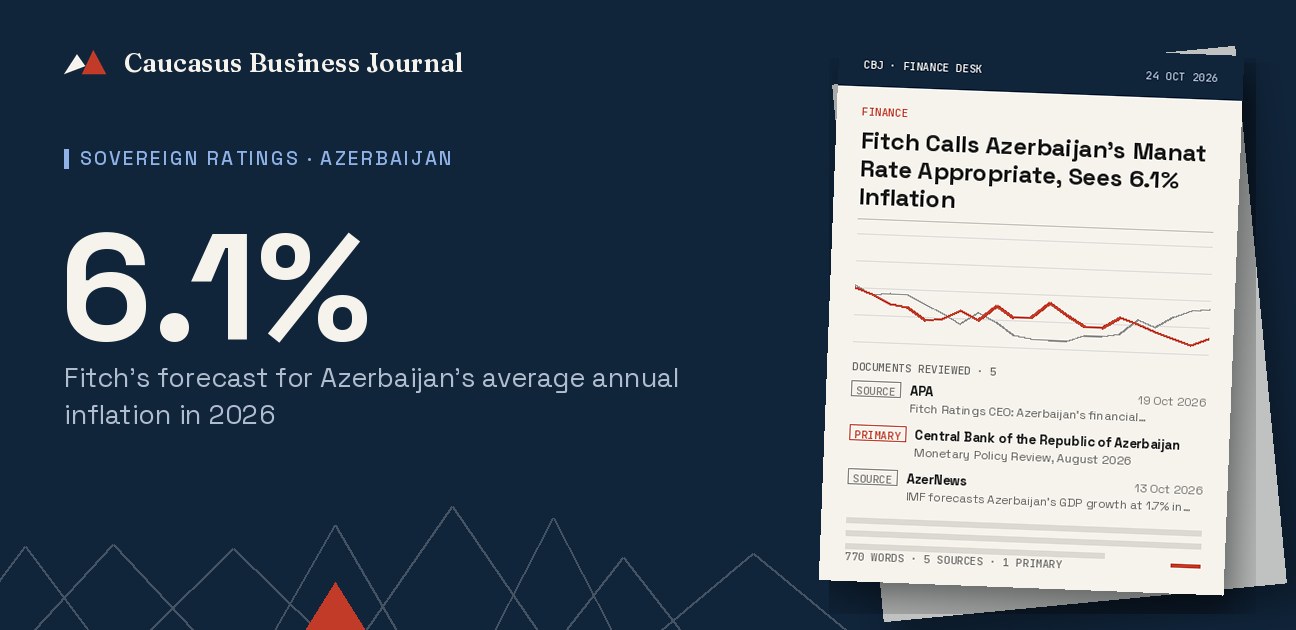
Fitch Ratings considers the Azerbaijani government's decision to maintain the manat's exchange rate against the US dollar "appropriate for the economic conditions" and expects average annual inflation of about 6.1% in 2026, Erich Arispe Morales said in an interview with APA published on 19 October. APA identified him as head of Fitch's sovereign ratings group for Eastern Europe.
Fitch's outlook on Azerbaijan's rating is Stable, which means it sees upward and downward pressures as balanced. Fitch forecasts a consolidated budget surplus of about 3.7% of GDP and a current account surplus of about 11% of GDP in 2026. Public debt is below 20% of GDP, against a median of about 57% for countries in the BBB category, Arispe Morales said. Fitch upgraded Azerbaijan back to investment grade in 2024, taking into account the country's strong financial reserves.
Fitch expects sovereign external assets, including those of the central bank and the State Oil Fund, to amount to about USD 91 billion in 2026, and net sovereign external assets to reach around 73% of GDP. The country's financial reserves, the central bank's monetary policy and the government's fiscal policy support the existing exchange rate, he said, and revenues from foreign trade and other international transactions should continue to exceed expenditures even if oil and gas prices decline.

Fitch expects inflation to average about 5.6% in 2027 and said these figures are high compared with countries with similar ratings. The Central Bank of Azerbaijan's July projections, published in its Monetary Policy Review for August 2026, put annual inflation at 6.1% at the end of 2026 and 5.8% at the end of 2027, with a return to the target range expected from the second half of 2027. Annual inflation was 5.8% in June, the review shows.
The IMF's October World Economic Outlook forecasts average inflation of 5.8% in 2026 and 5.6% in 2027, and growth of 1.7% in 2026, AzerNews reported. The central bank's July projections put 2026 growth at 0.5%.
The economy grew 1.5% year on year in January to September, according to State Statistical Committee data reported by Xinhua. The non-oil and gas sector expanded 2.6% to 71.7 billion manats, while the oil and gas sector shrank 1.2% to 30.3 billion manats.
The central bank will announce its next decision on the interest rate corridor on 29 October, brought forward from 4 November, Trend reported in September. At its previous decision, the bank kept the refinancing rate at 6.5% and the upper bound of the corridor at 7.5%, and cut the lower bound by 0.5 percentage points to 5% to encourage interbank trading amid excess liquidity in the banking sector. CBJ covered that decision in October.
The banking sector is currently not one of the main sources of concern for the sovereign rating, Arispe Morales said. He cited progress in digitalisation, lower reliance on external financing, adequate capital buffers and better asset quality, and said work is under way toward Basel III standards in reporting and prudential buffers. Low financial intermediation and high dollarisation, he said, make it harder for monetary policy to reach lending and deposit rates. CBJ's report on first-half banking data has more on the sector.
For companies that price imports, contracts or loans in manat, Fitch's assessment supports planning around the current exchange rate. The official rate averaged AZN 1.7 per dollar over the period covered by the central bank's August review. Inflation of around 6% still erodes margins on manat contracts, and the refinancing rate has stayed at 6.5% since the cut on 4 February.
For investors, the interview also sets out what could move the rating. Fitch said one of the factors it considers important for an upgrade is further improving the effectiveness of economic and financial policies, including more credible and predictable monetary policy, a better transmission mechanism and stronger consistency between fiscal and monetary policies. Governance quality and GDP per capita leave room for improvement compared with other investment-grade countries, it said. Fitch has observed progress in liquidity management in recent years but said a longer track record is important, and that using buffers for a more aggressive fiscal policy to stimulate growth would not be sustainable.