Business
Azerbaijan's Transit Cargo Tops 12m Tonnes in Nine Months

October 24, 2026

4
Min
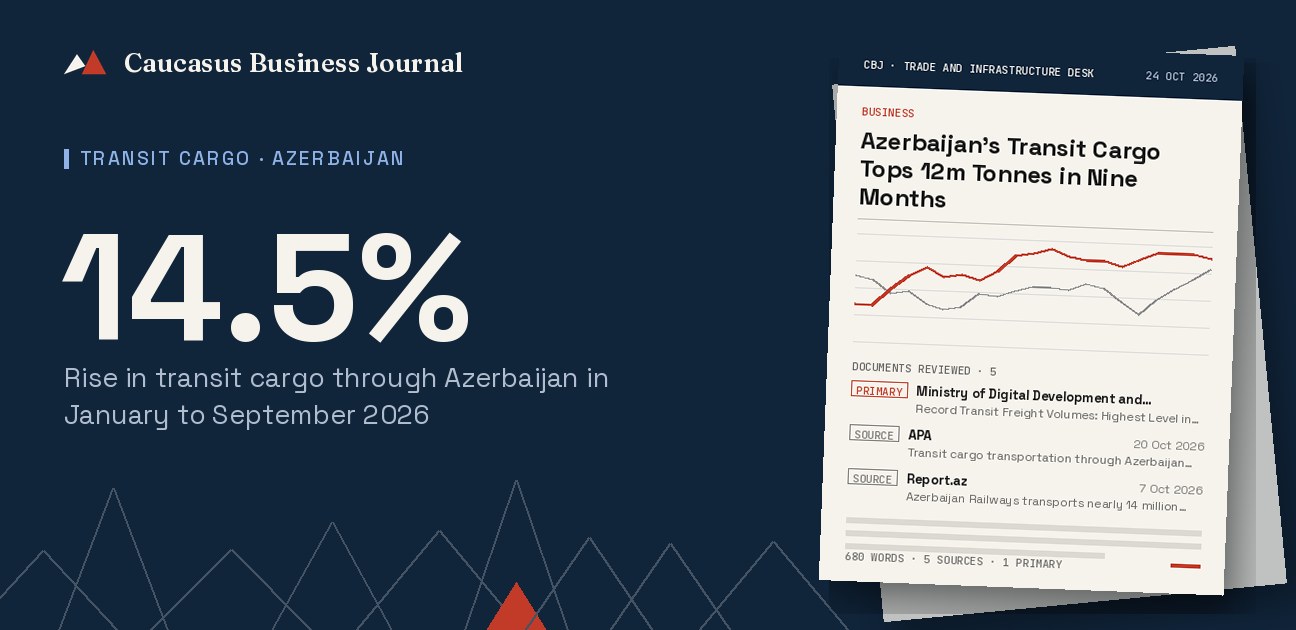
Transit cargo carried through Azerbaijan exceeded 12 million tonnes in January to September 2026, 14.5% more than a year earlier and the highest level in five years, the Ministry of Digital Development and Transport said in figures reported by APA on 20 October. Transit on the East-West route rose 20.2% and on the North-South route 19.0%.
Port volumes grew faster. Container handling rose 29% to 100,000 TEU and dry cargo handling 71% to 1.73 million tonnes in the nine months, the ministry said. It credited the development of transport and logistics infrastructure, digitalisation, closer coordination between institutions and wider international cooperation, and said changes in global trade routes had also raised demand for Azerbaijan's transit potential.
Growth has accelerated. For January to July, the ministry reported transit of more than 9.1 million tonnes, up 11.6%, with the East-West corridor up 16.5% and the North-South corridor up 14.3%, figures CBJ covered in August.
Rail carries much of the flow. Azerbaijan Railways (ADY) said it moved nearly 14 million tonnes of cargo in January to September, up 11%, including 5.7 million tonnes of transit, up 15%, Report.az reported on 7 October. The company's East-West transit rose 20% and its North-South transit 26%. In September alone, its total freight rose 29% and its transit 37% year on year.
Kazakhstan, at the eastern end of the Caspian crossing, reported faster growth. Freight on the Trans-Caspian International Transport Route rose 30% in January to September and container transit from China westward rose 64%, Kazakhstan's Ministry of Transport said, according to Inbusiness.kz. For January to August, the route's volumes had risen 22%, CBJ reported.
The two governments have also signed an agreement on developing the route. Kazakhstan's ministry said the parties committed to ensuring the route's necessary capacity, keeping tariff rates stable, giving their liner vessels priority service in ports and using a single transport document for combined rail and sea shipments, with a single logistics operator offering one-stop services. The agreement is open to other states. The ministry's account gave no capacity figures.
Azerbaijan's ministry expected transit to exceed 16 million tonnes in 2026, of which 5.5 million tonnes would pass through the Middle Corridor, Fariz Aliyev, head of its Department of Transport Policy, told a conference in Baku on 6 October. Extending the nine-month total over twelve months gives about 16 million tonnes, a CBJ calculation, in line with that forecast.
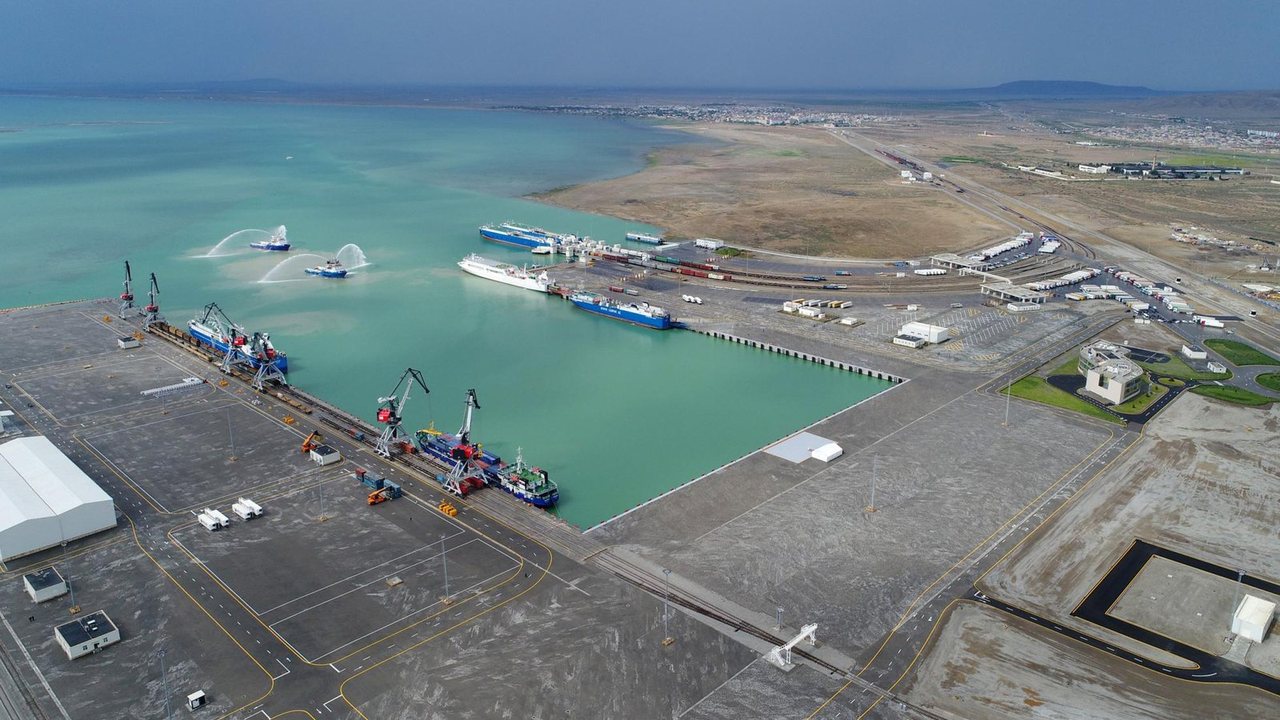
Container volumes are approaching port capacity. The ministry said the annual container capacity of the Baku International Sea Trade Port has risen from 100,000 TEU to 160,000 TEU and that vessel handling time has fallen from about 20 hours to 4 to 5 hours. Nine-month handling of 100,000 TEU equals about 83% of that capacity on an annualised basis, a CBJ calculation. The ministry's January to July release gave the container capacity of the Port of Alat as 150,000 TEU; on that figure, the same handling would equal about 89%. The port's own forecast of about 123,000 TEU for the full year would equal about 77%. Its cargo capacity of 15 million tonnes a year is planned to rise to 25 million tonnes and 500,000 TEU under the current expansion. The Baku-Tbilisi-Kars railway's annual freight capacity is 5 million tonnes after modernisation.
For shippers, forwarders and logistics investors, the ministry's figures show transit on both main corridors through Azerbaijan up by about a fifth in the nine months, and port container handling rising twice as fast as total transit tonnage. With container handling running at an annualised 83% to 89% of port capacity before the expansion is finished, depending on which of the ministry's capacity figures is used, headroom at peak times is limited. If the tariff stability and port priority in the Kazakhstan and Azerbaijan agreement are applied in practice, costs and transit times on the Caspian leg should become easier to plan.
Clarification, 25 October 2026: This article now notes that the ministry's January to July release gave the port's container capacity as 150,000 TEU, against the 160,000 TEU in its nine-month figures, and gives the utilisation on both figures.