Finance
Azerbaijan's State Oil Fund Assets Reach $74bn in Nine Months

October 24, 2026

4
Min
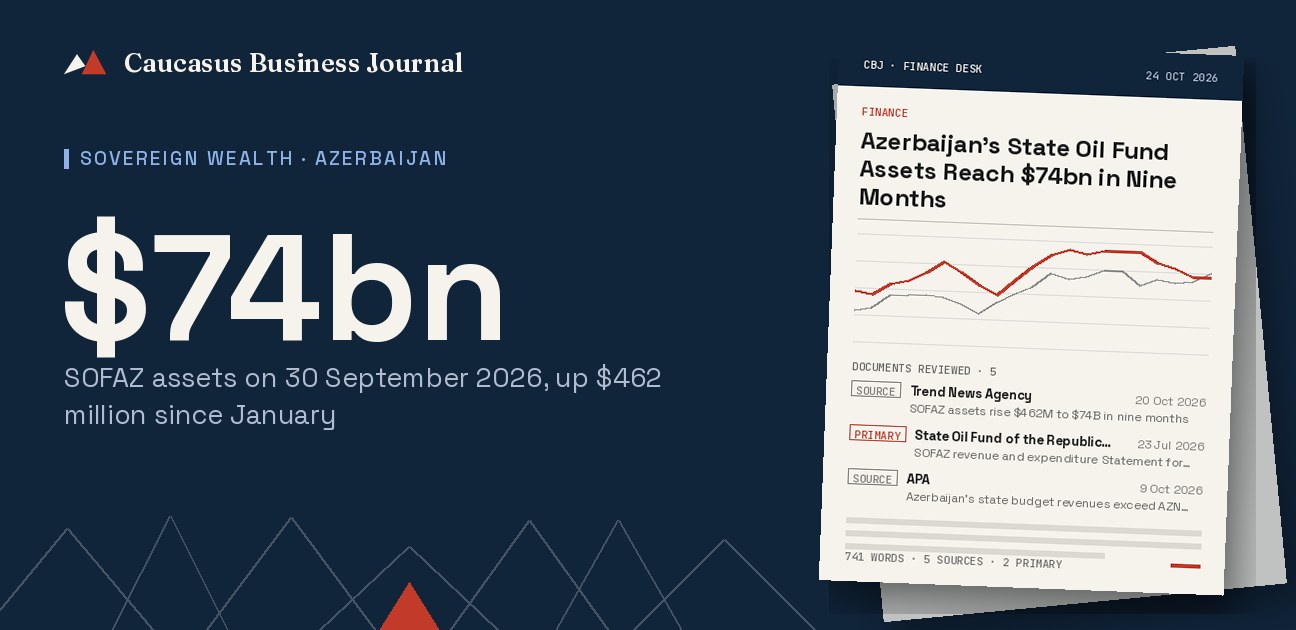
The State Oil Fund of Azerbaijan (SOFAZ) held assets of $74 billion, or 125.8 billion manat, on 30 September 2026, up $462 million (786 million manat) from the start of the year, according to the fund's report on revenues and expenditures for January to September 2026, as reported by Trend on 20 October.
The nine-month figure reflects a third-quarter recovery. In its revenue and expenditure statement for January to June, published on 23 July, SOFAZ put its assets at USD 72,596 million on 30 June, down from USD 73,542 million at the start of 2026. By CBJ's calculation, assets grew by about $1.4 billion between July and September.
Revenue for the nine months reached 12.34 billion manat ($7.26 billion). Oil and gas projects brought in 8.74 billion manat, including 6.57 billion manat from the Azeri-Chirag-Gunashli field and 565.1 million manat from sales of Shah Deniz gas and condensate. Asset management generated 3.6 billion manat.
Trend's breakdown of oil and gas revenue includes 1.39 billion manat ($818.2 million) received from the sale of the state's stake in Southern Gas Corridor CJSC. The first-half statement listed no such item. Excluding it, oil and gas revenue for the nine months was about 7.35 billion manat by CBJ's calculation, of which 4,953.4 million manats was booked in the first half.
Budget expenditures came to 9.68 billion manat, of which 9.6 billion manat was transferred to the state budget. SOFAZ had transferred 6,420.0 million manats in the first half, so third-quarter transfers were about 3.2 billion manat, by CBJ's calculation. The fund also spent 27.7 million manat on state programmes and projects and 25.5 million manat on management.
The transfers are a large part of public revenue. State budget revenues reached 29.31 billion manat in January to September, 2.8% above forecast, according to budget execution figures reported by APA. SOFAZ's 9.6 billion manat equals about a third of that total, by CBJ's calculation.
Changes in gold prices and exchange rates produced an off-budget expense of 1.87 billion manat ($1.1 billion) over the nine months. That was narrower than the 3,688.1 million manats booked for the first half, so valuation moves added roughly 1.8 billion manat in the third quarter, by CBJ's calculation. In its first-half statement, SOFAZ said gold surged through the first quarter, then fell sharply late in that quarter and kept declining through the second as real yields climbed.
SOFAZ holds most of Azerbaijan's strategic foreign currency reserves. The Central Bank of Azerbaijan's Monetary Policy Review for August 2026 put strategic foreign exchange reserves at $85.8 billion at the end of June and the central bank's own reserves at $13.2 billion. SOFAZ's $72.6 billion on the same date made up the remainder. CBJ has followed the build-up in earlier coverage of the reserves.
In an interview with APA published on 19 October, Erich Arispe Morales of Fitch Ratings said Fitch expects sovereign external assets, including those of the central bank and SOFAZ, to reach about USD 91 billion in 2026, and noted the government's target of raising SOFAZ assets to USD 100 billion. He said using the buffers for a more aggressive fiscal policy to stimulate growth would not be sustainable and would eventually reduce them.
For contractors and suppliers that depend on public investment, SOFAZ transfers remain one of the budget's main funding sources, so the fund's oil income has a direct bearing on state spending. Azeri-Chirag-Gunashli alone supplied 6.57 billion manat, most of the recurring oil and gas income, and the nine-month total was lifted by a one-off receipt.
For banks, investors and importers, the size of the buffer underpins the manat: Fitch said reserves, monetary policy and fiscal policy together support the existing exchange rate. The swing in valuations between the first half and the third quarter also shows how far gold and currency markets can move the fund's value within a few months. CBJ's report on the 2027 to 2030 budget framework sets out the government's medium-term revenue assumptions.