Energy
Azerbaijan envoy tells Berlin gas conference it supplies 14 countries

September 18, 2025

3
Min
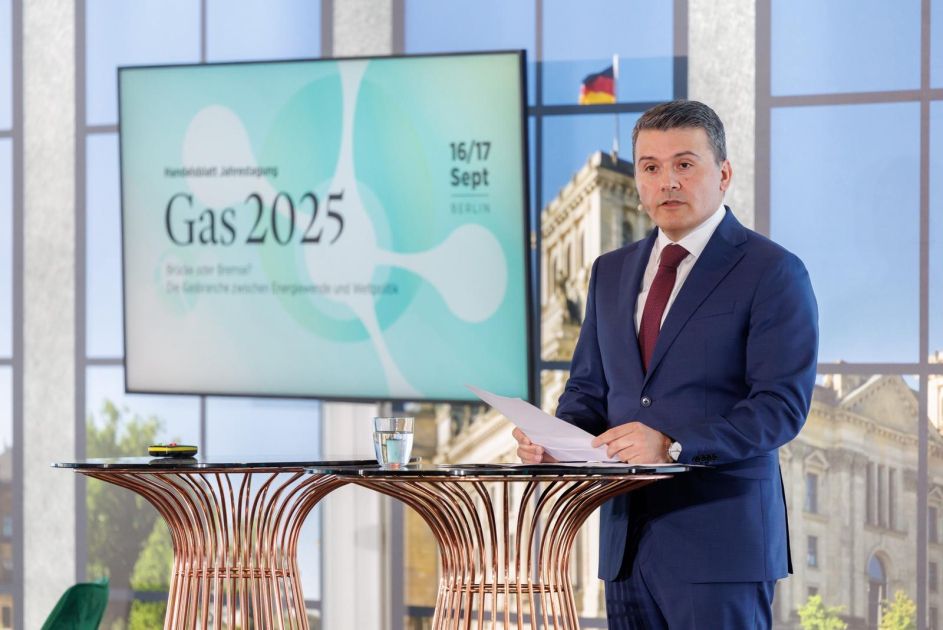
Azerbaijan exported 25.3 billion cubic metres of gas in 2024, 13 billion of it to Europe, its ambassador to Germany, Nasimi Aghayev, told Handelsblatt's annual gas conference in Berlin in September 2025, according to an Azernews report published on 18 September 2025. The conference ran under the title "Gas 2025: Bridge or Brake? The gas sector between energy transition and world politics".
Aghayev gave a keynote, at the newspaper's invitation, titled "Azerbaijan's Contribution to Europe's Energy Security in an Era of Geopolitical Challenges". He said Azerbaijan then exported gas to 14 countries, 11 of them in Europe and nine of those in the European Union, and that its deliveries to Europe had risen by more than 50 per cent in two years.
Germany had no physical Azerbaijani supply at the time. Aghayev pointed to long-term contracts with the German companies Uniper and SEFE covering 3 billion cubic metres a year, and said Azerbaijan had never halted deliveries despite geopolitical risks.

The ambassador linked the energy case to the peace process with Armenia. He referred to the peace agreement initialled in Washington the previous month and to the joint declaration that the two leaders signed at the White House on 8 August 2025, saying it would open trade routes and bring infrastructure and investment. At the same meeting both leaders signed separate economic agreements with the United States covering trade, transit, energy, infrastructure and technology, the White House said.
He also described plans to adapt the Southern Gas Corridor, the pipeline chain from the Caspian to Italy, for green hydrogen over time. Agreements for wind and solar projects with a combined capacity of more than 10 GW had been signed, he said, and a planned Black Sea submarine cable would carry electricity from the South Caucasus to the EU.
In the question session, the moderator asked about expanding the Southern Gas Corridor, renewable energy projects and the results of the COP29 climate summit held in Baku, Azernews reported. The report does not quote his answers.
Physical flows to Germany began in January 2026, when Azerbaijani gas reached Austria and Germany for the first time through the Trans Adriatic Pipeline and onward networks. That took the number of buyer countries to 16, Azernews reported on 17 January 2026, citing German press coverage that put Azerbaijan's 2025 exports to Europe at 12.8 billion cubic metres and SEFE's ten-year contract at 1.5 billion cubic metres a year.
Export volumes since then are set out in our report on the 16-country supply list.
The peace track has moved more slowly. A year after the Washington meeting, the agreement remains initialled but not signed, while the company meant to run the transit route it was to unlock has already been structured.