Business
Kazakhstan Needs 64% Growth a Year on the Middle Corridor

November 24, 2026

4
Min
Kazakhstan's container traffic on the Middle Corridor grew 64% in the first ten months of 2026, and that is exactly the rate it has to sustain every year until 2029 to hit the government's own target. The country is now spending about $5bn on three highways meant to keep that pace possible, led by the $1.65bn Beyneu–Saksaulsk road to the Caspian ports of Aktau and Kuryk.
The Ministry of Transport told a meeting on 19 November that Kazakhstan handled 1.234 million twenty-foot equivalent units (TEUs) of containers from January to October, up 8% year on year, The Times of Central Asia reported. The Middle Corridor, formally the Trans-Caspian International Transport Route, carried 57,300 TEUs, up 64%. China–Russia traffic rose 0.7% to 454,000 TEUs and China–Europe traffic rose 4.8% to 404,000 TEUs.
So the fastest-growing route is also the smallest: 57,300 TEUs is about 4.6% of the national total. The growth rate makes headlines; the share explains why ministers keep announcing roads, railways and ferries.
Kazakhstan's stated aim is 300,000 TEUs a year on the Middle Corridor by 2029. Annualising this year's ten-month figure gives roughly 69,000 TEUs for 2026. Getting from there to 300,000 in three years requires compound growth of about 63% a year. In other words, this year's 64% is not an outperformance to celebrate; it is the minimum run-rate the target demands, repeated three more times on a much larger base.
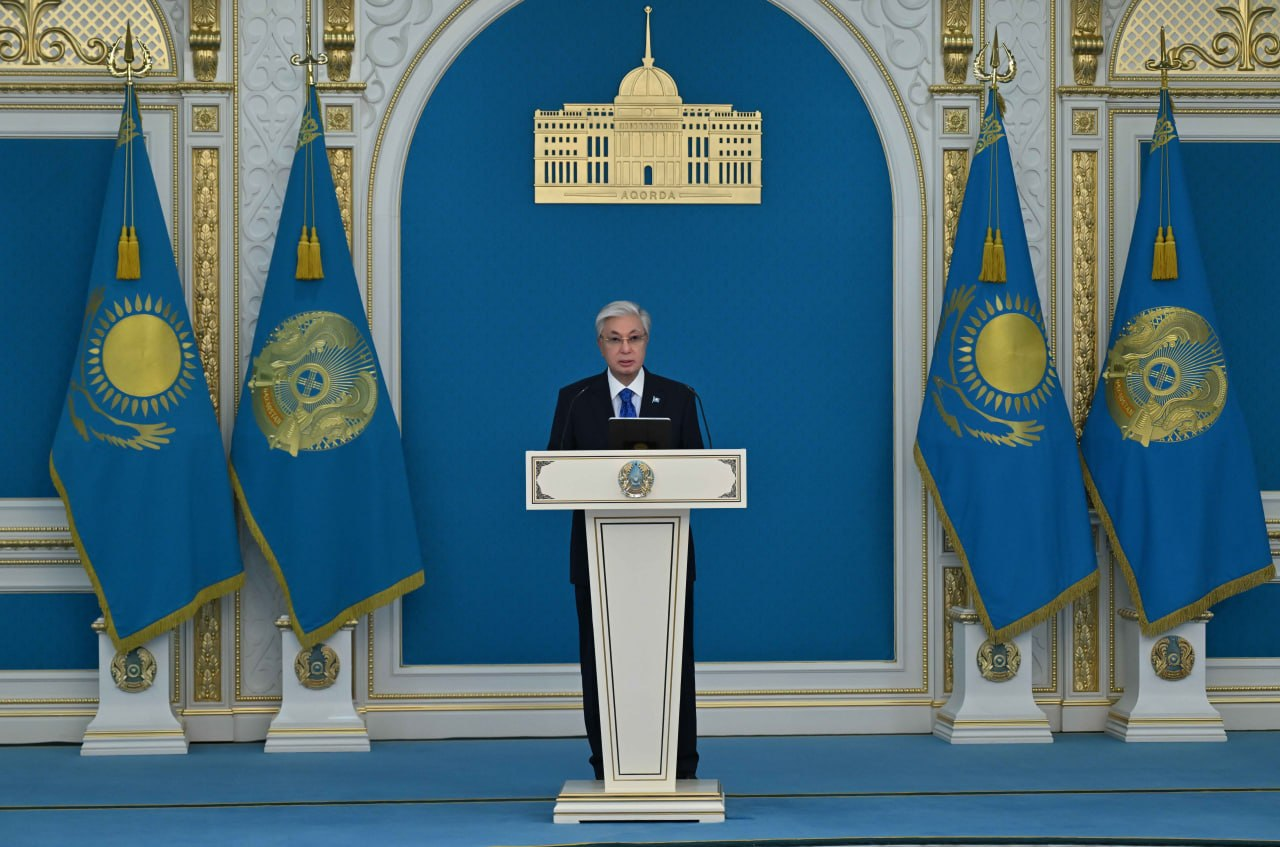
That is the context for the road programme. On 3 August President Kassym-Jomart Tokayev launched construction of three highways by teleconference. The centrepiece is the Beyneu–Saksaulsk road, about 800 km through the Mangystau, Aktobe and Kyzylorda regions, which he proposed calling the Aral-Caspian Highway. He said it would cut the China–Europe freight distance through Kazakhstan by nearly 1,000 km and delivery times by up to three days, according to The Astana Times.
Alongside it, the 312-km Ulgaysyn–Saksaulsk road (about $1.6bn, financed entirely by the Development Bank of Kazakhstan) and the 462-km Kyzylorda–Saksaulsk road ($1.767bn) are being rebuilt. Officials expect annual freight on the routes to rise 2.5-fold to 13.2 million tonnes once complete.
For Beyneu–Saksaulsk, the Development Bank of Kazakhstan has committed up to $413.8m, about a quarter of the $1.65bn cost, Trend reported on 23 November. The rest is expected to be arranged with the World Bank's IBRD, the EBRD and the Asian Development Bank. At roughly $2m per kilometre, the road is a large bet for a corridor that still moves less than one container in twenty.
The road is one link in a longer chain. The 201-mile Mointy–Kyzylzhar railway is due to open by the end of 2026 and the Bakhty–Ayagoz line, a third rail crossing to China, in 2027. On the Caspian, Kazakhstan and Azerbaijan signed agreements in November on the "Caspian Bridge" ferry concept, targeting at least 8 million tonnes a year, and on a joint intermodal terminal at the Port of Baku in Alat. CBJ has tracked the corridor's targets in the three-state plan for 30 million tonnes by 2029 and the rail side in AIIB's proposed loan for the Darbaza–Maktaaral line. Our Middle Corridor hub collects the rest.
Faster roads to Aktau and Kuryk do not raise corridor capacity on their own. They move the constraint to the ports, the ferries and the Azerbaijani and Georgian legs. Transport officials at the 19 November meeting called for faster container trains and shorter wagon turnaround, including on neighbouring networks, a sign that the slowest link is often outside Kazakhstan's control.
Financing: only the Kazakh development bank's share of Beyneu–Saksaulsk is committed; the multilateral portion is described as expected. Timing: official statements cite both 2028 and 2029 for completion. Demand: the 64% growth comes from a small base and is partly driven by shippers avoiding routes through Russia; if that pressure eases, the case for a $5bn road programme rests on domestic traffic. And the Caspian itself is shrinking, which raises dredging costs at the ports the highway is meant to feed.
The ministry did not publish whether the 57,300 Middle Corridor TEUs are included within the 404,000 China–Europe figure or counted separately. The multilateral financing shares for Beyneu–Saksaulsk have not been published.
Full-year 2026 Middle Corridor volume. To stay on the path to 300,000 TEUs in 2029, it needs to land near 69,000 TEUs; anything materially below means the target is slipping before the new roads open. CBJ will report the figure when the ministry publishes it.
Sources: The Times of Central Asia; Trend; The Astana Times; Ministry of Transport of Kazakhstan.
Photo: Press service of the President of Kazakhstan (Akorda), via The Astana Times