Business
Uzbekistan's Economy in 2026: Growth Built on Inflows, Not Gold

November 24, 2026

4
Min
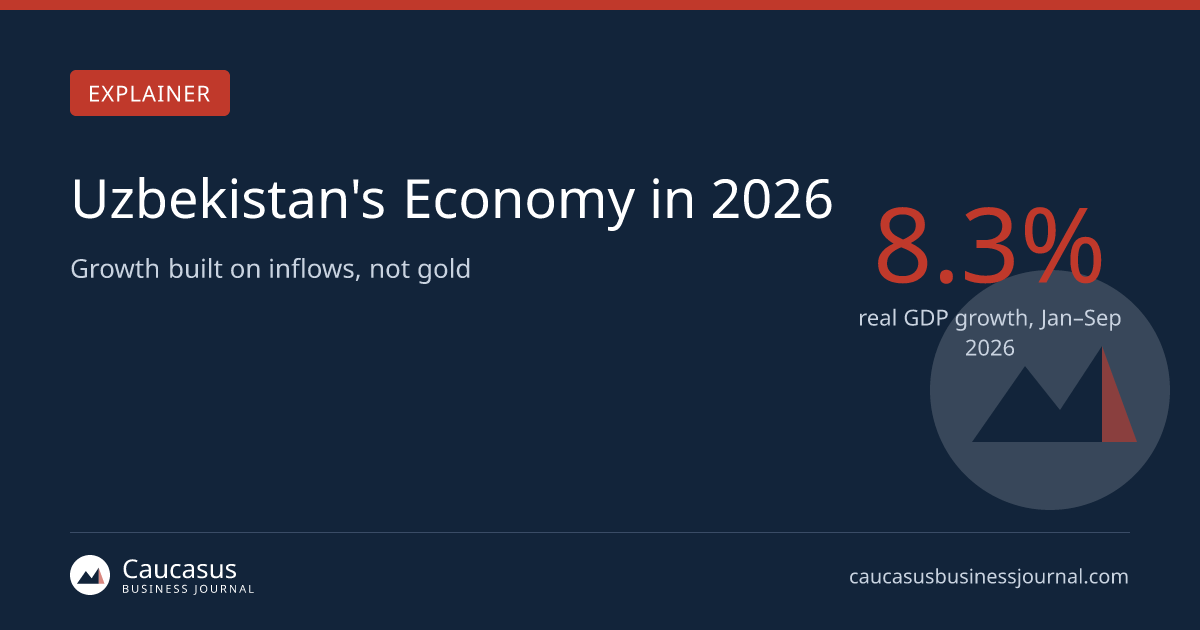
Uzbekistan's economy grew 8.3% in real terms in the first nine months of 2026, faster than the same period of 2025 and well above the government's own 6.6% target for the year. But the number that best explains how the economy works right now is a different one: imports rose 15.7% over the same nine months while total foreign trade grew only 6.3%. Uzbekistan is growing on investment and inflows, not on what it sells abroad. That is both its strength and its exposure.
The National Statistics Committee puts nominal GDP for January–September 2026 at 1,755.5 trillion soums, up 8.3% in real terms on a year earlier. The same period of 2025 grew 7.6%. Industry led the deflator at 112.1%, and the overall GDP deflator was 108.4%. The IMF expects full-year growth of around 7.8%, and the draft 2027 budget is built on nominal GDP of $232bn and $65bn of foreign investment.
Capital, not commodities. The single clearest fact of 2026 is that money arriving in Uzbekistan has outpaced money earned by its exports. Foreign investment and loans passed the full-year 2025 total by the end of September. Multilateral lenders are a large part of that flow: the World Bank's portfolio in the country is nearing $16bn and the EBRD's has passed $7bn.
Households, through remittances. The Central Bank of Uzbekistan says incoming remittances grew by nearly 9% this year and names them, alongside investment, rising incomes and high budget spending, as the forces keeping demand strong. That is why inflation has fallen only slowly, to 6.4% in September, against a 5% target the bank does not expect to reach until the end of 2027.
The state's balance sheet. Tashkent has put $8.4bn of state assets up for privatisation, and the investment pipeline runs through energy, copper, tourism and urban development. Privatisation proceeds and project finance both show up as investment, which flatters growth while the assets are being built.
Gold is Uzbekistan's largest export and its main buffer. This year that buffer thinned: as CBJ reported this month, gold exports fell 79% over the period covered, while capital inflows kept the soum steady. The central bank noted faster growth in non-gold exports, which is the right direction. But with imports rising more than twice as fast as total trade, the current account now leans on continued inflows rather than on bullion sales.
The mechanism matters for anyone pricing Uzbek risk. When gold exports are high, the state earns hard currency directly. When they fall, the economy depends on lenders, investors and migrants continuing to send money. Both can keep growth above 7%. Only one of them is under Tashkent's control.
Inflows reverse. Growth built on investment and remittances is exposed to conditions abroad: a slowdown in Russia, where many Uzbek migrants work, or tighter global credit would hit demand quickly.
Gold stays weak. If gold exports do not recover in 2027, the gap between imports and exports has to be closed by more borrowing or a weaker soum.
Inflation sticks. The central bank has signalled the key rate could fall to single digits within three years, but only if inflation reaches 5%. A strong-demand economy makes that harder, which means high borrowing costs for longer.
Execution. Privatisation and project pipelines announced at forums do not always become signed contracts and finished plants. The 2027 targets assume they mostly will.
We could not find an official, current breakdown of how much of the $44.1bn in foreign investment and loans is equity versus debt, which would show how much of the inflow must eventually be repaid. Statistics for January–September of earlier years were revised after the population and agricultural censuses, so long-run comparisons should be treated with care.
The full-year 2026 GDP release in January: if growth holds above 8% while gold exports stay down, it will confirm that Uzbekistan's expansion is now driven by capital inflows rather than commodity earnings. The test after that is the central bank's first rate cut. If it comes in the first half of 2027 with inflation below 6%, the model is working. If inflation is still above 6% by mid-2027, expect rates to stay at 14%.
Related: Uzbekistan's Economy Grows 8.3% in Nine Months · Uzbekistan's Foreign Trade Rises 6.3% to $65.4bn
Sources: National Statistics Committee, GDP January–September 2026; Kun.uz, GDP grows 8.3%; Daryo, Central bank keeps key rate at 14%; Daryo, Key rate unchanged in November; Kun.uz, Inflation slows to 6.4%; Daryo, Key rate could fall below 10%; Central Bank of Uzbekistan, key rate rationale, July 2026
Image: Caucasus Business Journal