Diplomacy
Tokayev, Putin: Trade Nears $30bn, 124 of 178 Projects Done

November 27, 2026

3
Min
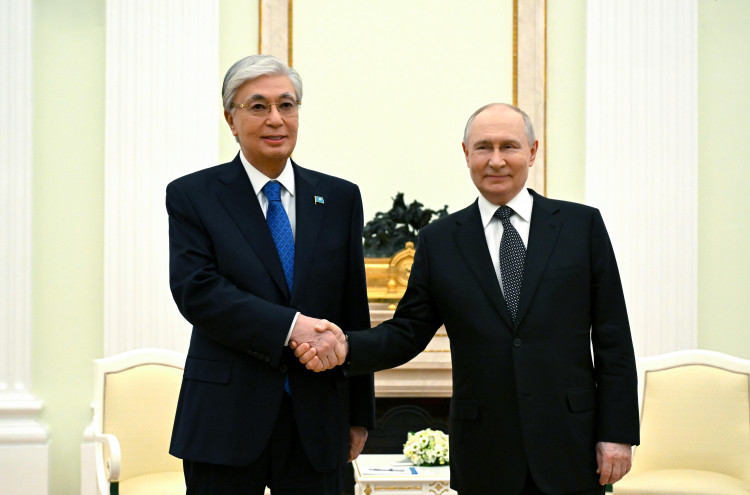
Kazakh President Kassym-Jomart Tokayev met Russian President Vladimir Putin in Moscow on 26 November 2026. According to the Akorda presidential website, both sides said bilateral trade is approaching US$30 billion, and Putin said settlements in national currencies now exceed 90 percent.
The talks took place ahead of the AI Journey conference, which Putin described as organised by Sberbank. The meeting produced no new signed agreements on the official record. Its value for business is the scorecard: a progress count on existing projects, and a clear push to move the partnership towards technology, transport data and energy.
Tokayev said the intergovernmental commission is following up on the outcomes of Putin's state visit to Kazakhstan in May 2026. Of 178 projects on its agenda, he said, 124 have been implemented. The rest are under way or close to completion.
Tokayev also named Sber and Yandex, saying Yandex Kazakhstan is one of the country's major employers. He said Kazakhstan gives Russian companies in its market "every possible assistance". The leaders discussed trade, investment, energy, industry, agriculture, transport and logistics, the Akorda page says.
In his speech to the conference, Tokayev set out the technology side. He said Kazakhstan has declared 2026 the Year of Digitalization and Artificial Intelligence, adopted a Law "On Artificial Intelligence" and a Digital Code, and now ranks 16th in the UN E-Government Development Index. In the text of his address, he said exports of Kazakh IT services exceeded $1 billion last year, and that companies in the Astana Hub have a combined revenue of $7 billion since 2019.
He linked AI to infrastructure in two ways. First, he said Kazakhstan and Russia could eventually build a full digital transport corridor, supported by the Smart Cargo and AI Jol projects and a pilot electronic waybill. He added that national information systems must become compatible. Second, he said data centres raise demand for electricity, so power supply and grid reliability matter. He pointed to the first Kazakh nuclear plant, at Balkhash, which is being built with Russia and led by Rosatom.
The two presidents also toured an exhibition. The Akorda report on the visit says Kazakhstan showed six areas, including GovTech, AI in Transport and FinTech, while Russia showed AI used in education, healthcare, urban planning and the oil industry.
The trade figure is close to a target Tokayev set a year ago. Reporting by Finansy Mail on the November 2025 Kremlin talks said Tokayev wanted turnover to reach $30 billion, and that Putin put trade at $27.8 billion in 2024. So the 2026 statement is a sign of steady progress, not a jump. The Akorda page gives no new turnover data for 2026, so the exact figure is still unconfirmed.
The currency point matters for companies. Putin's figure of more than 90 percent in national currencies is lower than the "almost 100 percent" he cited in 2025, according to that report. The two statements are not the same kind of measure, so they should not be read as a trend. Still, firms that sell to Russia should expect to be paid in roubles or tenge, and to carry the exchange-rate risk.
The 124 of 178 count is useful, but the official page does not list the projects. Investors cannot yet tell which are large and which are small. The emphasis on a digital transport corridor also suggests Astana wants data standards, not only rail and road capacity, to be part of the Russia route.
The page records Tokayev praising the Declaration adopted at the trilateral meeting of Xi Jinping, Putin and Donald Trump in Shenzhen. It gives no detail, so this article does not assess it.
Sources: Akorda, meeting with Putin; Akorda, Tokayev address to AI Journey 2026; Akorda, AI exhibition visit; Finansy Mail, November 2025 talks.
Image: Akorda (Office of the President of Kazakhstan), via akorda.kz