Business
Built for Export: Why Norm Added Cement Capacity in an Oversupplied Market

November 24, 2026

6
Min
Azerbaijan makes more cement than it uses. Its largest producer has just added capacity anyway. The decision only makes sense as an export bet, and the national statistics show both why that bet is rational and where it could go wrong.
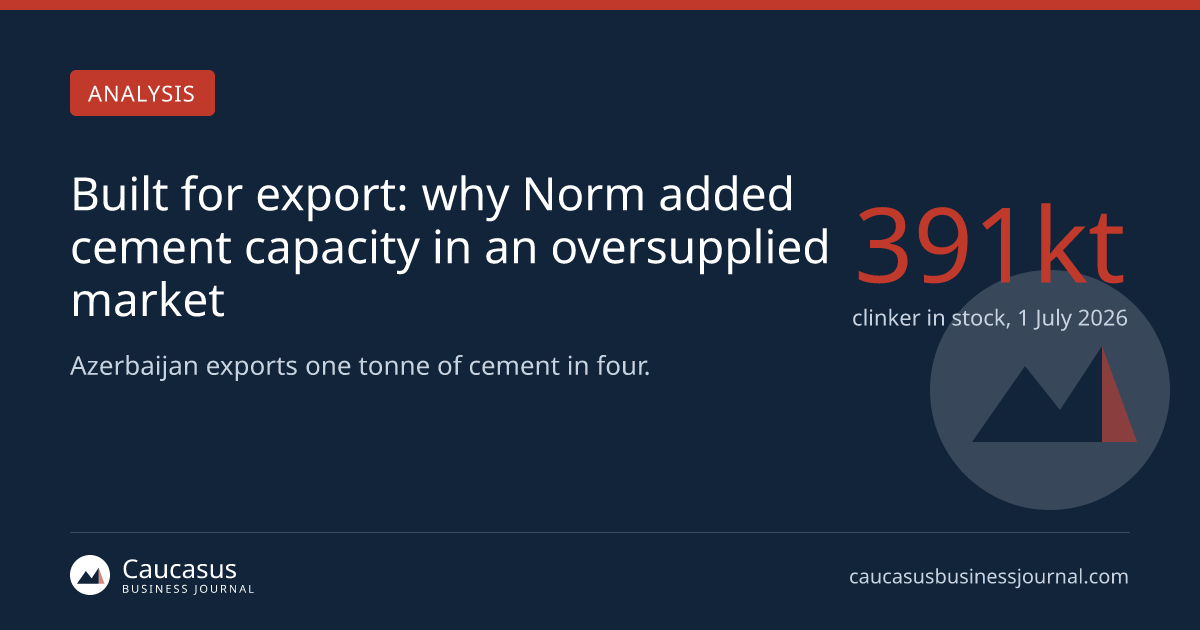
On 1 July 2026, Azerbaijani producers were holding 391,000 tonnes of clinker in stock, according to State Statistics Committee data reported by Trend. That is roughly a fifth of the 1.91 million tonnes of clinker the country produced in the whole first half of the year.
Clinker is the intermediate product of cement making: the kiln output that is ground with gypsum and other additives into finished cement. A stockpile of that size is not a rounding error. It is a market telling producers that home demand is not absorbing what the kilns can make.
Six months earlier, Norm, the cement maker within NEQSOL Holding and by the group's description the largest cement producer in the South Caucasus, completed an expansion that raised its annual clinker capacity from 1.76 million tonnes to 2.0 million.
Those two facts are not in contradiction. Read together, they describe a strategy.
The expansion, completed in January 2026, added about 240,000 tonnes a year of clinker capacity, a near 14% increase, delivered with BTIEC, Gebr. Pfeiffer and Claudius Peters. Chief executive Henning Sasse was unusually direct about the context: he said domestic cement supply currently exceeds demand, and that the added capacity supports both future infrastructure needs and the development of clinker exports to regional markets.
Companies rarely volunteer that their home market is oversupplied in the same breath as announcing more capacity. The statement is useful precisely because it removes the ambiguity. This is not capacity for Baku. It is capacity for the corridor.
The same announcement contained two further details that matter more than the headline. Norm cut the clinker factor in its cement by 5% over the previous year, freeing about 85,000 tonnes of clinker for additional cement output. And it remains the only producer of oil-well cement in Azerbaijan, exporting it to several Central Asian countries; in 2021 it became the first producer in the South Caucasus to obtain API certification for the product.
The macro data explains the logic.
Home demand is flat to soft. Azerbaijan produced 4.14 million tonnes of cement in 2025, up just 1.7%, while the total value of construction-materials output fell 4.3% to AZN 1.46 billion. Concrete production fell 10.7%. In the first half of 2026, cement output fell a further 4%, to 1.85 million tonnes.
Clinker is moving the other way. Clinker output fell 11.9% in 2025 to 3.95 million tonnes, then rose 3% in the first half of 2026 to 1.91 million, even as cement output declined. More clinker and less cement is the signature of an industry producing the intermediate product for somewhere other than the domestic bag market.
Exports are already a quarter of the business. Cement and clinker exports reached about 957,000 tonnes in 2025, up roughly 13%, according to the Azerbaijan Construction Manufacturers Association, which puts exports at nearly 25% of national cement production. In the first half of 2025 alone, the State Customs Committee recorded 449,800 tonnes, up 33.8% year on year.
A sector where one tonne in four leaves the country is no longer a domestic construction story. It is a regional trade story, and that changes which variables matter.
Cement is heavy and cheap per tonne, which normally limits how far it can travel profitably. Clinker is easier to ship and store than finished cement, and it lets the buyer grind locally to its own specifications. Exporting clinker rather than cement is how a producer with surplus kiln capacity reaches markets that have grinding mills but not enough kilns.
The clinker-factor reduction points the same way. Using less clinker per tonne of cement at home frees kiln output for sale abroad without building another kiln. It is also the main lever the cement industry has on carbon intensity, which becomes a commercial consideration as buyers in and around Europe start to price embedded emissions.
Oil-well cement is the higher-margin edge of the same position. It is a specification product tied to drilling activity, it carries certification barriers that commodity cement does not, and Norm sells it into a Central Asian market where upstream activity is the customer base.
This is where cement meets the rest of the group's thesis. Norm's export case depends on the same east-west logistics that the Middle Corridor is meant to improve: Caspian shipping to Central Asia, rail and road west towards Georgia and Türkiye. The group-level bet on cables and minerals along that axis has a bulk-commodity counterpart in cement, and it is the one that earns revenue today rather than in 2027.
It also helps explain the company's work on alternative raw materials, including its earlier trial using drill cuttings in cement production. Each of these moves is aimed at making a tonne of Azerbaijani clinker or cement cheaper, or cleaner, to sell.
Export markets can close as fast as they open. Regional cement trade is exposed to trade-defence measures. A neighbour facing its own oversupply can impose duties or quotas, and clinker is an easy product to target.
Logistics cost is the margin. For a low-value bulk product, freight decides profitability. Congestion or tariff increases on Caspian shipping or Georgian rail would hit cement before they hit higher-value cargo.
Inventory is a warning as well as a signal. 391,000 tonnes of clinker in stock can be read as export capacity waiting for ships, or as product that is not finding buyers. The data does not distinguish between the two.
Domestic demand could stay weak longer than planned. The case for the expansion assumes infrastructure spending eventually absorbs more at home. If it does not, the plant runs below its new capacity.
Norm does not publish company-level production, export volumes, prices or profitability, so its share of national output and of the 957,000 tonnes exported cannot be established from public sources. CBJ also could not locate full-year 2026 customs data or a destination breakdown of cement exports. National figures above are as reported from official statistics by Trend, AzerNews, CemNet and Global Cement; company figures are from Norm's own January 2026 announcement.
Three numbers, all published by the State Statistics Committee or the State Customs Committee: whether full-year 2026 clinker output rises while cement output falls; whether 2026 exports clear one million tonnes; and whether the clinker inventory on 1 January 2027 is lower than the 391,000 tonnes recorded in July. If all three move that way, the expansion was an export strategy that worked. If stocks keep rising, it was capacity ahead of demand.
Sources: International Cement Review, 8 January 2026 (Norm capacity expansion, oil-well cement, clinker factor); International Cement Review, 21 January 2026 (2025 national output, citing State Statistical Committee data via AzerNews); Global Cement, 16 March 2026 (2025 exports); Global Cement, 25 July 2025 (H1 2025 customs data); Global Cement, 11 August 2026 (H1 2026 output and inventories, citing Trend). Figures as published.