Global
Kazakhstan pitches Caspian green power link at COP31

November 12, 2026

4
Min
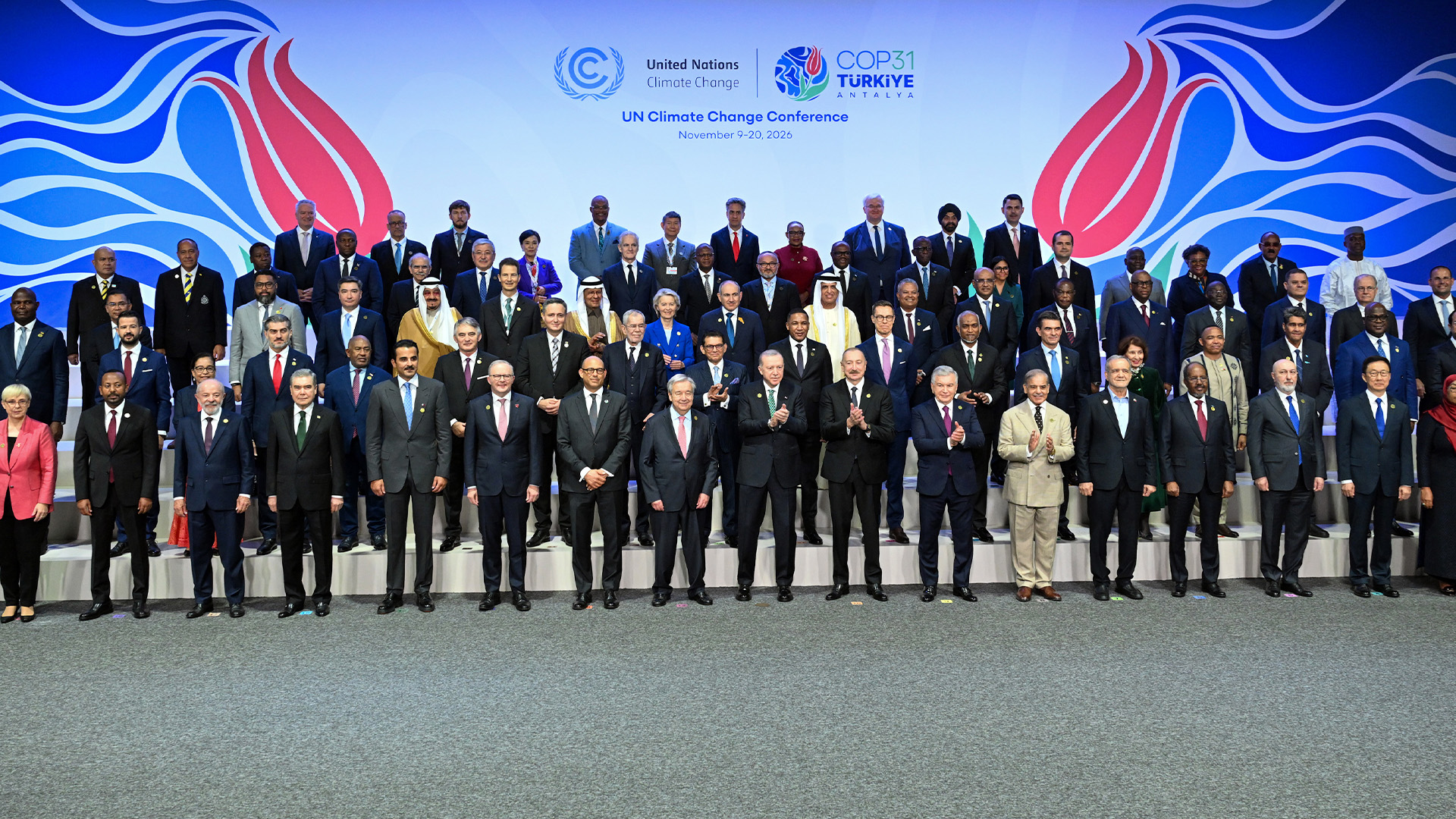
Kazakhstan used the COP31 UN climate summit in Antalya on 11 November to put the trilateral green power corridor with Azerbaijan and Uzbekistan back in front of investors. Prime Minister Olzhas Bektenov, attending COP31 on the instruction of President Kassym-Jomart Tokayev, stressed the importance of the joint project to build a corridor for exporting clean electricity, according to the official website of the Kazakh Prime Minister. The national pavilion separately presented a green energy route to Europe across the Caspian Sea.
The deals the government listed from Antalya did not include a new corridor agreement. The pitch matters because it signals that Astana still treats the Caspian link as a flagship export project while the engineering case is being tested, and because the delegation used the same visit to sign renewable and gas deals that the government valued at about $1.2 billion.
Mr Bektenov told delegates that the share of renewables in Kazakhstan's energy mix had quadrupled over six years to 8% in 2026, with a target of 15% by 2030, as Trend also reported. The deals signed in Antalya cover a 150 MW wind farm in Turkistan region, a 1 GW wind project in Kostanay region and the installation of 1.35 million remotely read smart gas meters under the Aqyl Energy project, the government said. Before the trip, The Astana Times reported that Kazakhstan was preparing about 28 cooperation documents for COP31, including 19 memorandums of understanding.
The legal base is in place. The strategic partnership agreement on producing and transmitting green energy was signed in Baku on 13 November 2024, and Kazakhstan's Senate passed the ratification law on 9 April 2026, after the Majilis, sending it to the president for signature, Interfax reported. The concept is a submarine cable across the Caspian seabed carrying power from Kazakhstan and Uzbekistan to Azerbaijan, with onward transmission towards Europe.
The Times of Central Asia put the subsea section at roughly 400 km between Kazakhstan and Azerbaijan, with Uzbekistan joining through overland lines. The Kazakh Energy Ministry has described the link as a high voltage direct current submarine cable, and Italy's CESI, which is preparing the feasibility study, has said up to 5 GW could be integrated by 2030, according to The Astana Times. The three grid operators, KEGOC, Azerenerji and National Electric Grids of Uzbekistan, are founding shareholders of a joint venture, Green Corridor Alliance, registered in Baku in July 2025.
Financing so far covers studies, not steel. The Asian Development Bank and the Asian Infrastructure Investment Bank signed a memorandum with the three energy ministries in April 2025 to support the feasibility work, according to the ADB. In October 2026 the AIIB had signed two grant agreements with Azerbaijan totalling $1.1 million, of which $1 million funds the first phase of the study and $100,000 supports preliminary planning for shore infrastructure for offshore wind, The Times of Central Asia reported. The ADB is providing a further $1 million, bringing its total to $2 million. The study itself is estimated at about EUR 1 million and is expected to be completed in May 2027, KEGOC told The Astana Times. No total construction cost appears in the published material.
The gap between rhetoric and readiness is wide. Renewables still supply only 8% of Kazakhstan's own energy mix, and the corridor depends on large surplus generation that does not yet exist, on a long subsea crossing, and on transit capacity west of Azerbaijan. Regional grid constraints are already a theme for lenders, as a recent assessment of Central Asian power connectivity showed. Wind projects such as the 1 GW Kostanay plant are the kind of supply the corridor would need.
The key milestones are the completion of CESI's study, expected in May 2027, any capacity or cost figures the three governments agree on, whether development lenders move from grants to project finance, and the AIIB annual meeting in Baku on 14 to 15 July 2027, a natural venue for the next step.
Sources: Prime Minister of Kazakhstan; Interfax; Trend; The Astana Times (COP31 documents); The Astana Times (corridor explainer); The Times of Central Asia; Asian Development Bank
Image: Office of the Prime Minister of Kazakhstan, via primeminister.kz