Business
Georgia and Eight Peers Finish Three CARTIF Protocols

November 12, 2026

4
Min
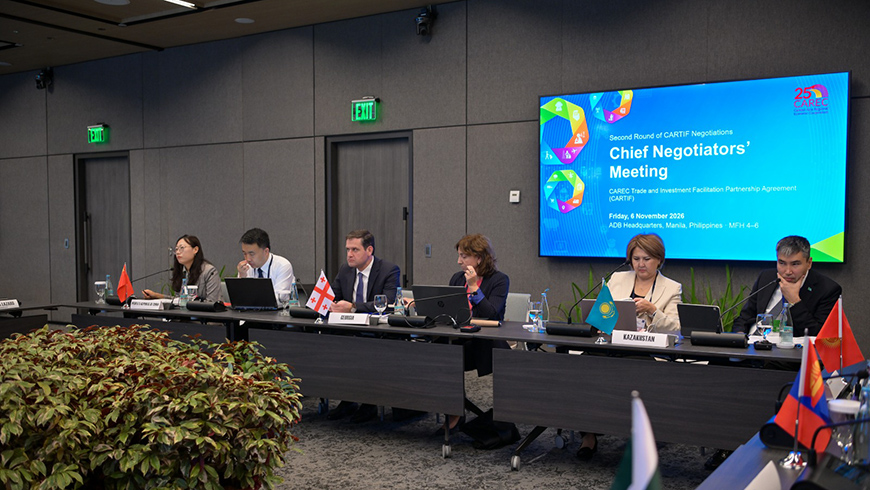
Georgia and eight other Asian economies finished work on three protocols of a new regional trade and investment pact at a negotiating round in Manila this month, the Ministry of Economy and Sustainable Development of Georgia said on 8 November 2026. The round itself took place on 6 November, according to Economist.kg.
Deputy Minister Genadi Arveladze, who led the Georgian delegation, called the agreement an important opportunity for Georgia because it would strengthen the country's position as a regional transit and trade hub. For a state that markets itself as the western end of the Middle Corridor, a rulebook covering investment, services and supply chains matters as much as another berth or railway upgrade.
The text is the CAREC Trade and Investment Facilitation Partnership Agreement, known as CARTIF. According to the ministry, it is the first agreement developed under the Central Asia Regional Economic Cooperation (CAREC) programme. Georgia, China, Mongolia, Pakistan, Turkmenistan, Kazakhstan, Tajikistan, Uzbekistan and Kyrgyzstan are taking part. The stated aims are to boost trade and investment, cut non-tariff barriers, develop digital trade and deepen economic cooperation.
Negotiators completed three protocols: on investment facilitation, on the regulation of services, and on participation in global value chains. Arveladze said he hoped talks on the remaining chapters would continue actively.
The Kyrgyz side offered a slightly different tone. Economist.kg reported on 9 November that Kyrgyzstan's economy ministry described a compromise on disputed provisions of the draft framework agreement, while the article's own text said positions had moved closer and work on those provisions continued. It was the first in-person round after online sessions in September and October, and Kyrgyzstan was represented by Deputy Minister Sultan Akhmatov. Formal negotiations opened on 3 June 2026 in Ulaanbaatar.
CARTIF was launched by the Bishkek Declaration at the 24th CAREC Ministerial Conference on 20 November 2025, according to an Asian Development Bank explainer published in February. The design pairs a binding framework agreement with initial protocols, and further protocols can be added later. Tariffs are not covered by the initial protocols, so the deal is about procedures and investment rules rather than customs duties.
The same explainer gives the economic case. CAREC has 11 member countries, and intraregional merchandise exports more than doubled in absolute terms between 2015 and 2024, yet the intraregional share has stayed at roughly 6% of members' total merchandise trade with the world. The region's trade and investment integration score rose only from 0.15 in 2006 to 0.17 in 2022.
Those numbers explain why Tbilisi is invested in a deal that does not touch tariffs. Georgia's value to Central Asian and Chinese exporters lies in transit, logistics and services, which are exactly the areas where non-tariff barriers bite. A predictable framework on investment and services could make Georgian ports, rail and freight operators easier to plug into longer supply chains, but only if the commitments are specific and enforced.
Two cautions apply. First, the ministry names nine negotiating participants against 11 CAREC members, so the pact does not yet reflect the whole programme. Second, the Georgian and Kyrgyz accounts differ on how much of the contested text has been settled. Completed protocols are real progress, but a framework agreement is only as strong as its hardest unresolved clauses.
Watch for the date and venue of the next negotiating round, whether the remaining chapters are published, and whether any government signals which provisions are still disputed. The next CAREC Ministerial Conference, a year on from the Bishkek Declaration, is a natural moment for a progress statement. For Georgia, the practical test is whether the final text includes enforceable transit and services commitments.
Sources: Ministry of Economy and Sustainable Development of Georgia; Economist.kg; Asian Development Bank (Development Asia)
Image: Ministry of Economy and Sustainable Development of Georgia, via economy.ge