Finance
EBRD Green Cities Gets €87m More From GCF, Open to Armenia and Georgia

October 30, 2026

3
Min
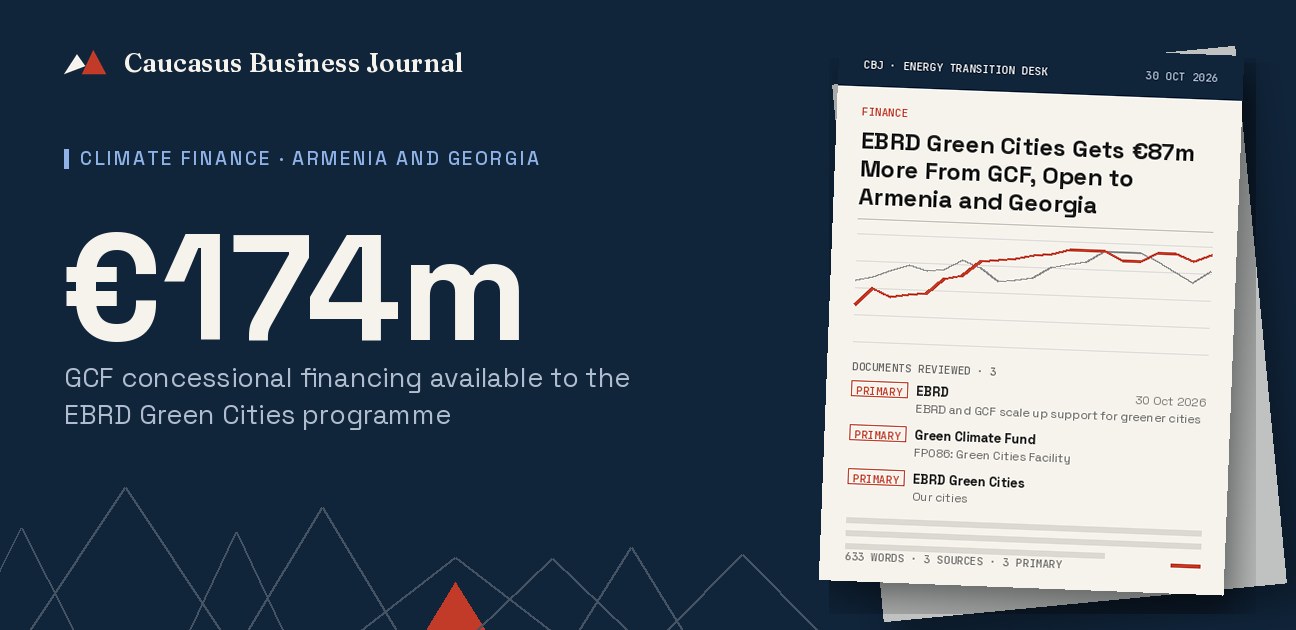
The Green Climate Fund has approved a second €87 million tranche for the EBRD Green Cities programme, doubling the concessional financing available to €174 million for cities, utilities and private firms in 15 countries, including Armenia, Georgia, Kazakhstan and Uzbekistan, the European Bank for Reconstruction and Development said on 30 October.
The EBRD announcement says the new money will help cities in eligible countries address climate mitigation and adaptation challenges through investment, policy support, capacity building and access to green finance. The 15 countries are Albania, Armenia, Bosnia and Herzegovina, Georgia, Jordan, Kazakhstan, the Kyrgyz Republic, Moldova, Mongolia, Morocco, North Macedonia, Serbia, Tajikistan, Tunisia and Uzbekistan.
The EBRD says EBRD Green Cities has more than 60 participating cities. It supports investment in urban transport, district energy, solid waste, renewable energy, smart solutions, water and wastewater, buildings, electricity distribution networks, street lighting, climate resilience and nature-based solutions. The EBRD says GCF concessional financing helps cities develop more ambitious investments while addressing affordability and bankability constraints, and mobilising additional public and private capital.

The first tranche of GCF money paid for the completion of eight Green City Action Plans, the tailor-made strategies that help a city identify, prioritise and tackle its most pressing environmental problems, and for ten investments. The EBRD singles out the River Bic Rehabilitation and Flood Protection project in Chisinau, Moldova, as the first time it has formally implemented a nature-based solution as part of a project. The second tranche, it says, will let the programme expand its support for investments in participating cities. The approval comes as the two institutions approach 10 years of broader partnership.
The programme's city directory lists Tbilisi and Batumi in Georgia and Yerevan and Gyumri in Armenia among its members, alongside Almaty, Shymkent and Ust-Kamenogorsk in Kazakhstan, Samarkand in Uzbekistan, Bishkek and Dushanbe. It also lists Ganja in Azerbaijan, although Azerbaijan is not among the 15 countries the EBRD names as eligible for the GCF concessional financing.
The GCF money sits within a facility approved eight years ago. The fund's project page for FP086, the Green Cities Facility, shows it was approved on 20 October 2018 with the EBRD as accredited entity, with an estimated completion date of 31 December 2040. The page lists a total project value of $579 million, 7.8 million tonnes of carbon dioxide equivalent expected to be avoided and 15.8 million people expected to gain resilience, and names the environment ministries of Armenia and Georgia among the national designated authorities.
The new tranche adds to a busy year of climate and infrastructure finance announcements for the region. CBJ has reported that the EBRD intends to raise its investment in Caspian shipping, and that the UN Biodiversity Conference in Yerevan drew more than $1.8 billion in new funding pledges.
Concessional money matters most where a project is needed but does not pay back at commercial rates, such as a bus fleet, a district heating network or flood defences. By blending GCF resources with its own loans, the EBRD can offer cities and utilities in Armenia and Georgia cheaper or longer financing for these projects, which in turn creates work for contractors, equipment suppliers and engineering firms that bid on them. The facility is also open to private-sector firms, so companies that run municipal services or supply energy-efficiency and waste technology can seek a share directly.
For Georgian and Armenian cities, the practical route runs through the Green City Action Plan: investments are identified in the plan and then financed. Cities that already have plans and a pipeline of projects are best placed to draw on the second tranche, while the EBRD has not said how the €87 million will be divided between countries.