Energy
Nobel Energy's Expansion Is a Services Bet, Not a Barrels Bet

November 24, 2026

6
Min
Read Nobel Energy's 2026 announcements in sequence and a pattern appears that none of them states outright. The group did not add a single new producing field. It added customers.
In June, its US subsidiary Audubon Companies won a Shell framework covering brownfield topsides work across all of Shell's deepwater assets in the US Gulf. In June, too, it signed a memorandum with UNG Overseas, the international arm of Uzbekneftegaz, to explore a services joint venture in Uzbekistan. In August, Wood Nobel Energy, its joint venture with the UK engineering group Wood, took the front-end engineering design contract for a new combined-cycle power plant in Nakhchivan. Over the same months its renewables unit, Enerso, moved a 25 MW solar plant in Nakhchivan from signed agreements to a presidential site briefing.
Four moves, three continents, one common feature: each sells engineering, operations or power, rather than owning more hydrocarbons in the ground. That is the most useful way to read the energy arm of NEQSOL Holding in 2026, and it changes which risks matter.
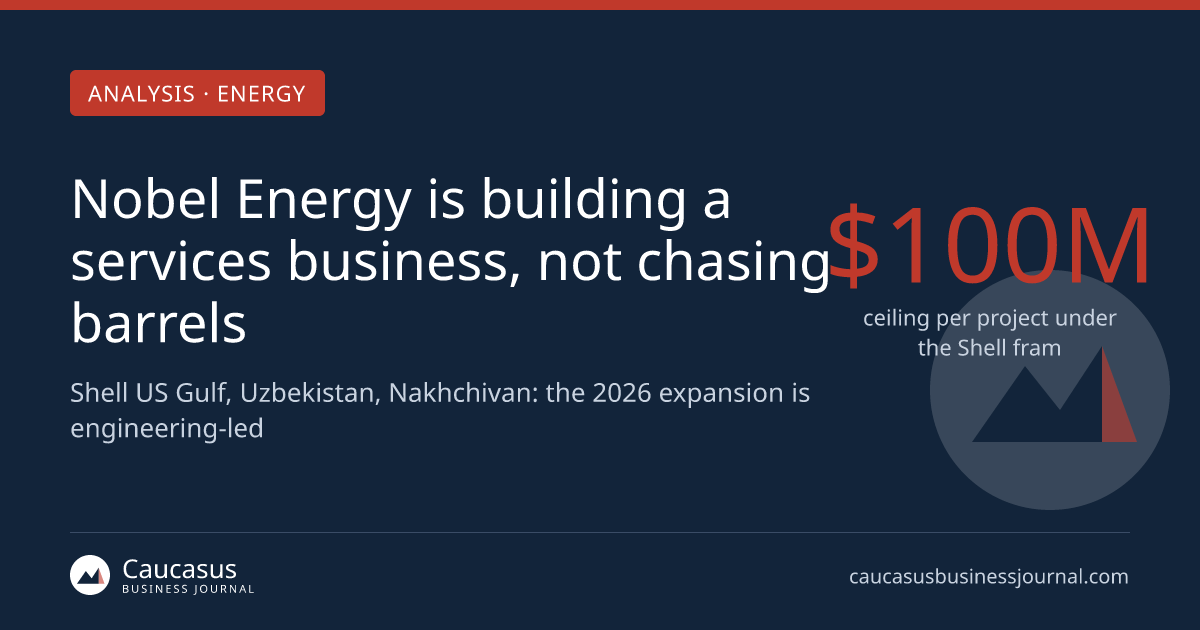
The headline figure in the Shell award is "up to $100 million" per project. It is easy to read that as contract value. It is not. According to Nobel's own release, it is the expected total installed cost of each individual project under a framework that spans Shell's US Gulf deepwater portfolio. How many projects Shell releases, and how much of each project's cost flows to Audubon rather than to equipment vendors and installers, is not disclosed.
That distinction is the whole business model. A framework agreement is not backlog; it is a place on the vendor list of one of the most demanding buyers in offshore oil and gas. The work it covers, operations, maintenance and upgrades to extend the productive life of ageing platforms, is the part of the offshore market that has held up best as operators keep existing infrastructure running rather than sanction new hubs. We covered the award in July; four months on, the more interesting question is what it is evidence of.
The mechanism is straightforward. An upstream stake ties a company's earnings to one basin, one reservoir and the oil price. A services business ties earnings to how much maintenance, modification and engineering its clients need, and that need is steadier, particularly in mature provinces. Services also scale with references: a Shell award is the credential that wins the next tender, in the Gulf or elsewhere.
Nobel's upstream footprint, as far as public filings and reporting show, is concentrated. Its best-documented producing asset is a 20% interest, held through Nobel Upstream (UK), in the Umid-Babek block offshore Azerbaijan, alongside SOCAR's 80%, operated by the Umid Babek Operating Company. Umid has produced gas since 2012. Appraisal drilling under a contract with Caspian Oilfield Service has been extended to the end of 2027, and the evaluation of Babek's reserves runs to the same horizon, according to Report.az. That is a long-dated, partner-operated position. It is not where the group's 2026 energy news came from.
The US Gulf. Audubon is the group's beachhead in one of the world's most mature offshore provinces, where life-extension work on existing platforms is a large and recurring market. Nobel describes the Shell contract as a milestone in its international growth strategy, and its chief executive, Vugar Samadli, framed it as a credibility award. That is a fair characterisation: in offshore services, the hardest contract to win is the first one with a supermajor.
Central Asia. The memorandum with UNG Overseas, signed on 30 June, sets out a framework to assess a joint venture offering EPC, operations and maintenance, asset-integrity management, drilling support, supply-chain management and training across oil and gas, power and water infrastructure in Uzbekistan. It is a statement of intent, not a contract. As we noted at the time, many memoranda never become standing ventures. Its value is optionality in a market modernising Soviet-era assets.
Nakhchivan. Here the group is doing both halves. Wood Nobel Energy was selected by SOCAR Midstream Gas Operations for the FEED of the Nakhchivan combined-cycle plant, a project set up under Presidential Order No. 418 of 23 December 2024 to raise generation and export capacity in the exclave. Separately, Enerso signed the investment, power-purchase and grid-connection agreements for the 25 MW Qərbi Üfüq solar plant in February. Nobel puts the investment at AZN 32 million and expected output at about 61 million kWh a year. Azerbaijan's energy minister said in February that renewables already account for 44% of Nakhchivan's installed capacity. Both projects sit inside the Green Energy Zone policy and the power-export logic of the corridor through Nakhchivan.
The Nakhchivan pairing is the clearest example of the strategy: engineering fees on a state-sponsored gas plant, and a contracted power-sales position on a solar asset, both tied to government policy rather than commodity exposure.
Frameworks can stay thin. If Shell releases few projects, the US Gulf award remains a credential with little revenue. Nobel has not disclosed work released to date.
Services margins are fragile. Brownfield offshore work is safety-intensive and exposed to cost overruns. One badly executed modification campaign does more reputational damage than a quiet year.
Memoranda expire. The Uzbek joint venture is not yet formed. Competition for Central Asian services work is crowded, with Western, Turkish, Chinese and Russian contractors all present.
Policy concentration. The Nakhchivan projects depend on state offtake and on the pace of the region's power-export plans. That is lower commodity risk, but higher single-counterparty risk.
Group capital competition. Within a holding that is also funding subsea cables and a titanium mine, an energy-services arm has to compete for capital and management attention. We set out that tension in October.
Nobel has not published Audubon's revenue, the number or value of projects released under the Shell framework, or a commissioning date for Qərbi Üfüq. We found no public confirmation that the UNG Overseas joint venture has been incorporated. Nobel Upstream's current share of Umid-Babek production is not disclosed in the sources we reviewed. We also could not confirm whether Nobel holds other producing upstream interests beyond Umid-Babek; this analysis treats Umid-Babek as the best-documented one, not necessarily the only one.
One test: a second named supermajor or national oil company award for Audubon or Wood Nobel Energy before the end of 2027. If it comes, the services pivot is working and the Shell framework was the reference it was meant to be. If it does not, the 2026 run will look like a cluster of one-off wins.
Sources: Nobel Energy releases of 23 February, 23 June, 30 June, 11 August and 12 August 2026; Report.az on Umid-Babek appraisal; Umid Babek Operating Company ownership as reported by SOCAR and trade press.