Mining
NEQSOL Holding Lands Critical Minerals Deal With Uzbekistan in Tashkent
August 2, 2026

4
Min
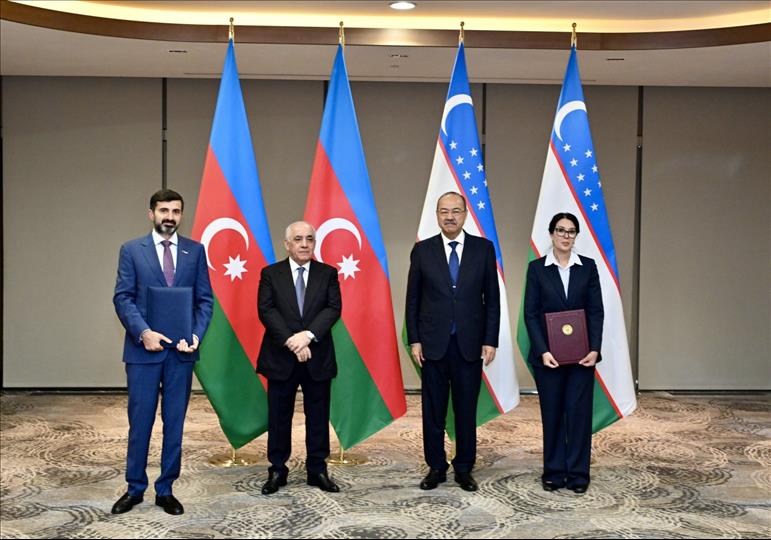
Pictured: NEQSOL Holding Chairman Yusif Jabbarov signs the critical minerals cooperation agreement with Uzbekistan's Ministry of Mining at the 5th Tashkent International Investment Forum, witnessed by the prime ministers of both countries. Photo: NEQSOL Holding / Trend News Agency (via MENAFN).
NEQSOL Holding has signed a cooperation agreement with Uzbekistan's Ministry of Mining Industry and Geology on the joint development of critical minerals — including titanium and other strategic raw materials — at the 5th Tashkent International Investment Forum (TIIF2026). The agreement was signed by Yusif Jabbarov, Chairman of the Board of NEQSOL Holding, and witnessed by the prime ministers of both countries, Ali Asadov of Azerbaijan and Abdulla Aripov of Uzbekistan.
The Tashkent ceremony slots into a wider Azerbaijan–Uzbekistan investment cycle that has steadily compounded since 2023, as Tashkent opens its mining and energy sectors to outside capital and Baku-headquartered conglomerates expand beyond their traditional Caspian footprint. The deal is the most institutional signal yet that critical minerals — the inputs that underpin aerospace alloys, defence systems, chemical processing and the energy transition — are now a regional category, not just a Western or Chinese supply-chain story.
For NEQSOL the agreement is the second strategic mining move in roughly a year. The group entered the sector in 2025 with the acquisition of UMCC Titanium in Ukraine, which operates the Vilnohirsk and Irshansk mining and processing complexes producing ilmenite, rutile and zircon concentrates for aerospace, chemical and industrial buyers. According to Trend News Agency's coverage of the Tashkent signing, the cooperation framework with Uzbekistan moves the parties from shared interest into practical joint-development territory, with titanium named explicitly as a target. Layered on top of NEQSOL's existing portfolio — Bakcell, AzerTelecom, Vodafone Ukraine, Nobel Energy and Norm cement — mining is hardening into a third operating pillar alongside telecom and energy.
The implications are sharpest for Uzbekistan, where the government has been actively courting outside operators to unlock under-developed gold and critical-minerals reserves. The Times of Central Asia notes that the broader signing day produced a basket of bilateral mining documents, of which the NEQSOL agreement is the most institutional. For Azerbaijan, the deal extends a deliberate strategic pattern — pairing Azerbaijani capital with Central Asian resources — that already runs through the Trans-Caspian fibre cable, the Middle Corridor logistics build-out and SOFAZ's expanding international portfolio.
The next signals to watch are project selection — which specific titanium-bearing deposits move first — and capital structure: whether NEQSOL deploys balance-sheet equity, raises external project finance or brings in a strategic minority partner, a question its new CEO Kirill Rubinski has explicitly framed as a 2026 priority. With Jabbarov visibly leading the chairman-level engagement and Rubinski running operations, NEQSOL is increasingly executing the institutional-governance posture it set out at its inaugural Baku townhall. The Tashkent agreement is the first significant cross-border deal signed under that posture.