Business
Middle Corridor Freight Volumes on Track for 10 Percent Growth in 2026

April 23, 2026

4
Min
Freight volumes along the Middle Corridor, the multimodal trade route linking China and Central Asia with Europe via the Caspian Sea and the South Caucasus, are projected to increase by 10 percent in 2026, building on the nearly 11 percent growth recorded in 2025, when transit volumes reached approximately 5 million tons.
The projection was made by Organization of Turkic States Secretary-General Kubanychbek Omuraliev at the Second Meeting of Heads of Government of the OTS in Baku on April 1-2, underscoring the corridor's growing importance as a Eurasian trade artery. The route, officially known as the Trans-Caspian International Transport Route, traverses China, Kazakhstan, the Caspian Sea, Azerbaijan, Georgia, and Turkey before reaching European markets.
The growth trajectory is being driven by several converging factors, including continued disruptions to the Northern Corridor through Russia, expanding Chinese manufacturing exports seeking alternative routes to Europe, and significant infrastructure investments by corridor states. The Diplomat noted that global supply chain disruptions have further accelerated interest in the route as a viable alternative to both the Russian land bridge and the Suez Canal maritime route.
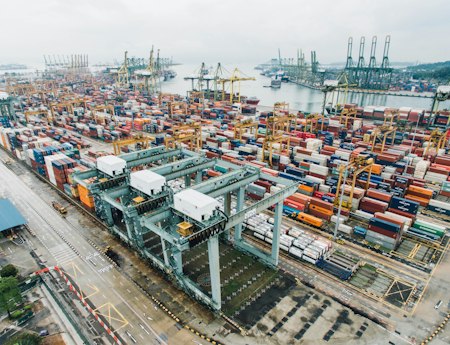
However, the corridor faces significant capacity constraints that threaten to limit its growth potential. Cargo volumes at the ports of Aktau in Kazakhstan and Baku in Azerbaijan have surged, with container processing times increasing roughly threefold. Rail networks in Azerbaijan and Georgia are struggling with shortages in locomotives and wagons, leading to congestion at key nodes.
Maritime transport across the Caspian Sea remains another bottleneck, constrained by limited vessel availability, outdated port infrastructure, and slow cargo-handling processes. Industry participants have called for coordinated investment in vessel fleets, port modernization, and digital logistics platforms to address these challenges.
On the infrastructure front, the expansion of the Baku-Tbilisi-Kars railway, growing Caspian port capacity, and the development of Georgia's Anaklia deep-sea port are all designed to address bottlenecks. Azerbaijan's Transport and Communications Holding is emerging as a cross-modal coordination platform, integrating the country's rail, maritime, and port assets into a unified framework, as reported by Aze.Media.
Azerbaijan and Georgia Sign BTK Railway Agreements to Boost Capacity