Business
EU Maps $14 Billion Investment Plan for Middle Corridor Through South Caucasus

April 23, 2026

4
Min
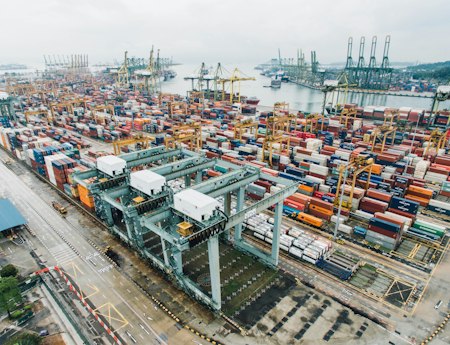
The European Commission has published an ambitious EU-funded meta-study highlighting critical infrastructure investment needs along the Middle Corridor—the Trans-Caspian trade route linking Europe to Central Asia through the South Caucasus and Turkey. The study forms the backbone of approximately $14 billion in planned EU funding under the Global Gateway initiative, targeting upgrades to rail, ports, border procedures, energy links, and digital connectivity.
The study arrives at a pivotal moment for the corridor. Cargo volumes on trade routes linking Europe and Asia via the South Caucasus and Turkey have quadrupled since 2022, driven by the rerouting of supply chains away from Russia and growing demand for alternative east-west logistics channels. With the right investments, analysts project that volumes could triple again by 2030.
Key stretches where infrastructure is identified as missing, outdated, or insufficient for current volumes include port facilities on the Caspian Sea, railway connections through Azerbaijan and Georgia, and border crossing procedures that remain cumbersome despite recent modernization efforts.
New EU-supported programs announced alongside the study include a €15 million initiative for customs efficiency and logistics harmonization, a €10 million partnership with the World Bank for feasibility and environmental studies, and a €5 million collaboration with the European Bank for Reconstruction and Development for project preparation.
Azerbaijan is responding to the opportunity by modernizing port operations at Alat on the Caspian coast and expanding rail freight capacity. Investments in the ports of Aktau and Kuryk in Kazakhstan, combined with expanded ferry services across the Caspian, have already reduced transit times significantly. More than 1,700 kilometers of existing rail lines are being modernized alongside 4,500 kilometers of new and upgraded rail infrastructure across the corridor.
Georgia is preparing upgrades to its Black Sea port facilities and road infrastructure to handle increased transit volumes. The country's strategic position as the corridor's gateway to European markets makes these investments critical for maintaining competitiveness against alternative routes.
However, a recent Carnegie Endowment analysis cautioned that the translation of EU headline funding figures into visible on-the-ground progress has at times moved more slowly than the rhetoric suggests. The report noted that political announcements can outpace actual implementation, and called for accelerated disbursement mechanisms to match the urgency of infrastructure needs.
The EU also agreed with Azerbaijan and the EBRD in January 2026 to launch a feasibility study for upgrading the railway through the Azerbaijani exclave of Nakhchivan, which could become a crucial link in an expanded corridor network following the Armenia-Azerbaijan peace agreement.