Innovation
The Caspian's First Data Cable Is Live. What It Changes for Central Asia

November 25, 2026

5
Min
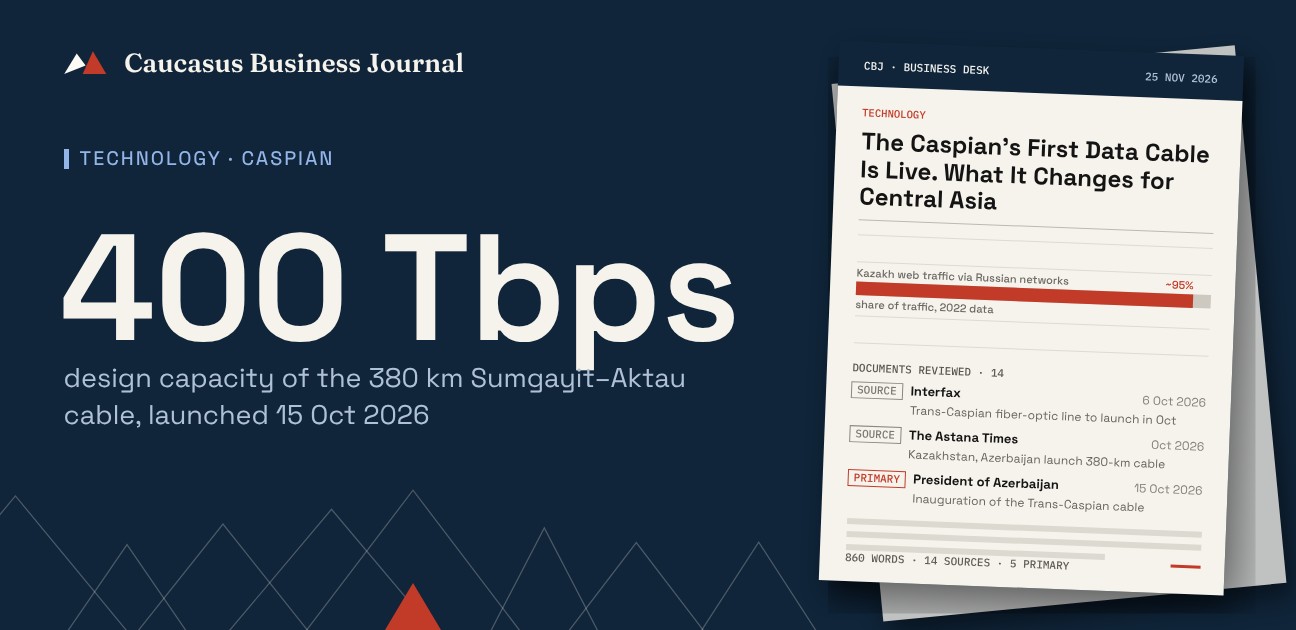
Six weeks after the presidents of Azerbaijan and Kazakhstan switched it on, the first fibre-optic cable laid across the Caspian seabed gives Central Asia a direct westbound data route that bypasses Russian networks. The cable is late, costs less than it sounds, and it is only the first link in a longer chain.
On 15 October 2026, President Ilham Aliyev and President Kassym-Jomart Tokayev jointly inaugurated, in an online ceremony, the Trans-Caspian Fiber-Optic Cable between Sumgayit in Azerbaijan and Aktau in Kazakhstan (The Astana Times; President of Azerbaijan). "This is a new type of corridor. It is not a transport corridor, but something new that fits into the modern era, the era of digitalization," Tokayev said at the launch.
The case for the cable is not speed alone. Approximately 95 percent of Kazakhstan's web traffic has transited Russian networks, and Kazakh internet providers source roughly 80 percent of their international bandwidth from Russian operators, according to figures compiled by the Jamestown Foundation's Eurasia Daily Monitor from 2022 data. Uzbekistan's external links run through Kazakhstan and then Russia.
Routed west through Azerbaijan, Georgia and the Black Sea, the Caspian link creates what the same analysis calls "the first sovereign east–west digital pathway out of Central Asia". The Astana Times reported that the line could also connect with submarine systems in the Mediterranean and Black seas.
The Kazakh side frames it as an investment magnet: the cable is expected to help attract global technology companies, cloud services and AI infrastructure to Kazakhstan. That ambition meets a hard ceiling. Kazakhstan, Uzbekistan and Kyrgyzstan together host just over 4,700 data-centre racks, and only 15 facilities are certified Tier III by the Uptime Institute (Carnegie Politika, Apr 2026). The cable does not fix that gap, but without an independent route out, new data-centre capacity would still depend on Russian transit.
The project is part of the Digital Silk Way, a programme NEQSOL Holding launched in 2018 to build a terrestrial and subsea fibre corridor through Azerbaijan, Georgia, Türkiye, Kazakhstan and Turkmenistan (Digital Silk Way). The holding has valued the wider programme at more than $250 million (Business Wire, Mar 2025).
The five-year slip against the 2019 target was attributed to partner changes, joint-venture restructuring, the pandemic and the 2020 oil price collapse, according to Eurasia Daily Monitor.
When construction began in March 2025, Yusif Jabbarov, then chief executive of NEQSOL Holding, described the line as the "most optimal and shortest route between Europe and Asia" (NEQSOL Holding). At the launch, Jabbarov, now chairman of the board, called it "a strategic investment in Eurasia's digital infrastructure" (Caspian News).
The Azerbaijan–Kazakhstan line is phase one. A second phase foresees a similar seabed cable on an Azerbaijan–Turkmenistan route, which would add a second east–west path and redundancy for the first (Submarine Networks). Turkmenistan has long preferred bilateral frameworks, and that segment is handled through the Azerbaijan–Turkmenistan intergovernmental commission rather than regional summit declarations.
On the western end, NEQSOL, through Vodafone Ukraine, works with Vodafone Group on the Kardesa submarine system linking Bulgaria, Georgia, Türkiye and Ukraine across the Black Sea. Together with the Caspian cable, it is designed to give the corridor an onward path to European networks.
The test from here is commercial rather than ceremonial: how much of Central Asia's international traffic the operators actually move onto the new route, and at what price compared with the established northern links. Neither operator has published traffic or pricing figures since the launch.
Image: Caucasus Business Journal
Disclosure: the publisher has a commercial relationship with an organisation mentioned in this article.