Energy
Azerbaijan Now Pipes Gas to 16 Countries as 2026 Europe Volumes Climb

June 28, 2026

5
Min

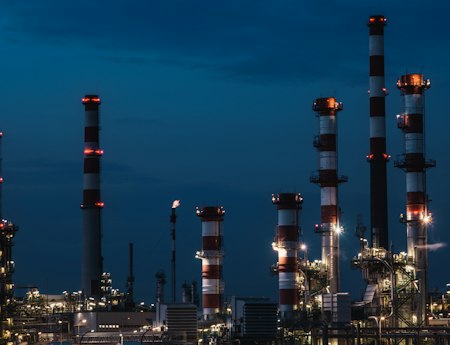
A natural gas pipeline of the kind that carries Azerbaijani supply westward through the Southern Gas Corridor toward Europe. Photo: Unsplash.
Azerbaijan has consolidated its position as one of the world's most widely connected pipeline-gas suppliers, with Baku now delivering natural gas to 16 countries, up from 12 a year earlier. The expansion was formalised during the 12th Ministerial Meeting of the Southern Gas Corridor Advisory Council, convened in Baku alongside the 4th Green Energy Advisory Council, drawing delegations from 27 countries, eleven international financial institutions and 49 energy companies.
The export numbers underline the scale of the build-out. Over the past year and the first four months of 2026, Azerbaijan exported 16.7 billion cubic metres (bcm) of gas to Europe, 12.8 bcm to Turkiye, 3.3 bcm to Georgia and 800 million cubic metres to Syria, Energy Minister Parviz Shahbazov has said. Total gas exports reached 25.2 bcm in 2025, with more than half of that volume flowing into the European Union.
The recipient list now spans Bulgaria, Croatia, Georgia, Greece, Hungary, Italy, North Macedonia, Romania, Serbia, Slovakia, Slovenia, Syria, Ukraine and Turkiye, with Germany and Austria added at the start of 2026. That breadth makes Azerbaijan the leading country worldwide by the number of states it supplies via pipeline, a distinction Baku has leaned on to frame itself as a reliable strategic partner amid Europe's continued effort to diversify away from Russian supply.
Sustaining the momentum will require new upstream volumes. SOCAR President Rovshan Najaf has signalled that Azerbaijan intends to keep raising natural gas output over the coming decades, with the Karabakh oil field due online in 2027 and the Shah Deniz compression project, full-scale Absheron development, and the Umid Phase-2 and Babek gas projects all targeted for 2029. Independent analysts have nonetheless cautioned that production growth has lagged the pace of Baku's export pledges, raising questions over how quickly headline volumes can rise.
For now, the dual-track message from Baku is that gas reliability and a longer-term green-energy ambition are complementary rather than competing. By convening its gas and green advisory councils together, Azerbaijan is positioning the Southern Gas Corridor as the backbone of present-day supply security while it courts investment in the renewable corridors meant to carry the next phase of exports to Europe.