Business
Azerbaijan Moves 25.9m Tonnes on Its Corridors

November 22, 2026

3
Min
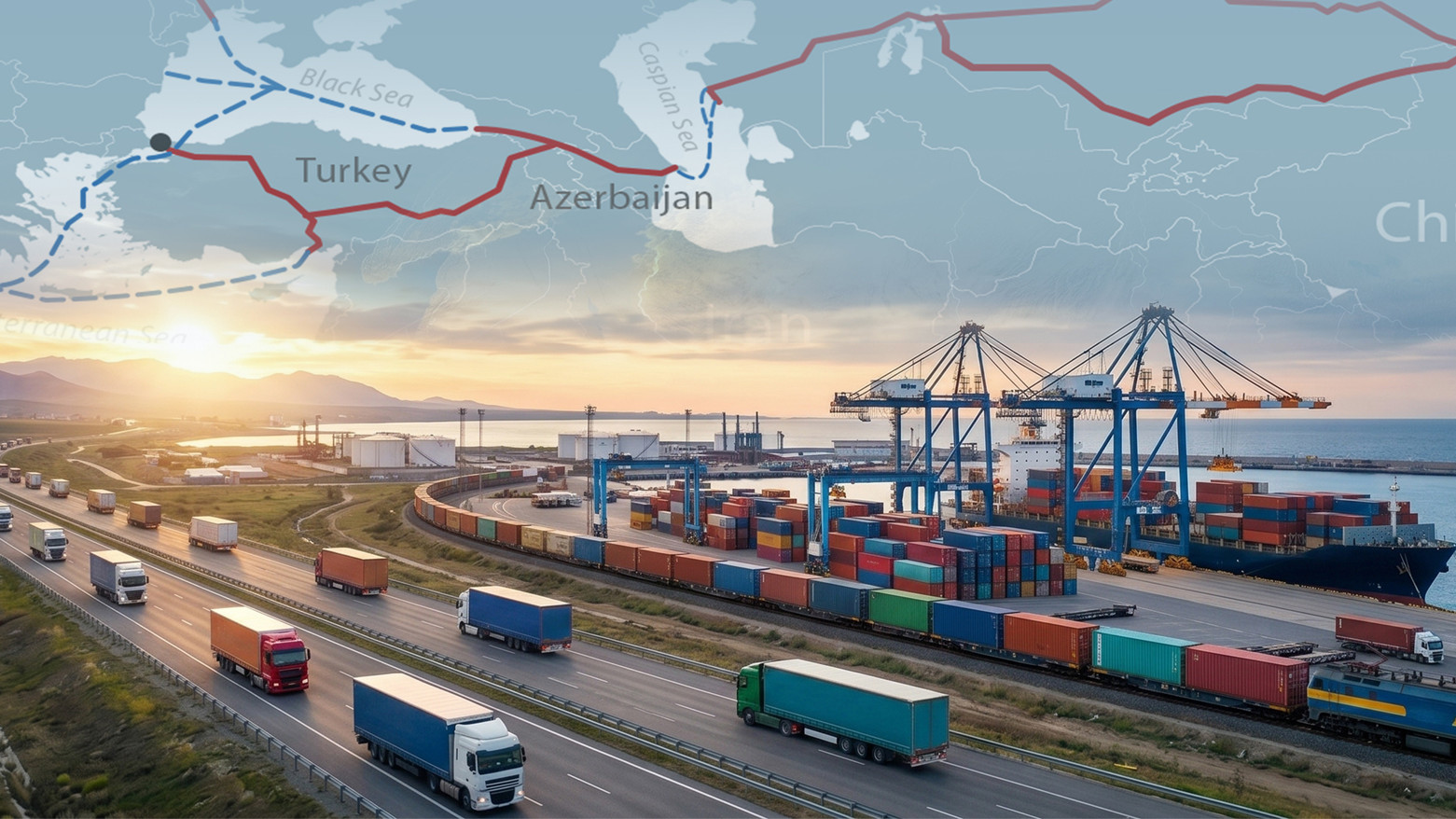
Azerbaijan moved about 25.9 million tonnes of cargo along its transport corridors in January to September 2026, with East-West routes carrying 14.741 million tonnes, according to State Statistics Committee data reported by Trend on 16 November. The data is six days old, but it is the fullest multi-modal picture of Azerbaijan's freight yet this year.
The figures matter because they show how much of Azerbaijan's traffic is now transit rather than domestic trade. Transit accounted for 47% of rail freight and 46.6% of road freight, which makes the country's logistics earnings increasingly dependent on neighbours' trade flows, including those along the Middle Corridor.
The Trend report split the total by mode: 12.081 million tonnes by rail, 5.3701 million by sea and 8.490 million by road. By route, the East-West corridor took 14.741 million tonnes, including 7.507 million on the Europe-Caucasus-Asia (TRACECA) corridor. The North-South corridor carried 6.867 million tonnes, the North-West 3.886 million and the South-West 447,000. We could not retrieve the original committee release, so the numbers are given as reported by Trend, and the shares below are our own calculations.
Earlier official data pointed the same way. The Ministry of Digital Development and Transport said on 10 August that transit freight exceeded 9.1 million tonnes in January to July, the highest in five years and 11.6% above the same period of 2025, with East-West up 16.5% and North-South up 14.3%. The ministry also said the Port of Alat's container capacity had been raised from 100,000 to 150,000 TEU and that its container throughput rose 20% to 72,370 TEU in the seven months.
On our arithmetic, East-West routes made up roughly 57% of the nine-month total and North-South about 26%. The east-west axis is the one that connects Central Asia and China to Europe through Azerbaijan and Georgia, so its weight suggests the Middle Corridor is the main driver of volume, not a niche.
Georgia shows the other end of that chain. Trend, citing Georgia's Ministry of Economy, reported in August that Georgian seaports handled 9.7 million tonnes in the first half, up 22% and a decade high, while Georgian Railways carried 6.9 million tonnes, up 10%. Growth on both sides of the border points to genuine corridor traffic rather than a one-off.
The weak spot is the sea leg. At 5.37 million tonnes, sea cargo is the smallest of the three modes, even though the Caspian crossing is where bottlenecks matter most. The ministry has said Alat is expected to reach 25 million tonnes and 500,000 TEU of annual capacity after expansion, up from 15 million tonnes now. Until that capacity arrives, rail and road will carry most of the load.
Sources: Trend, "Azerbaijan transports 25.9M tons via transport corridors in nine months"; Ministry of Digital Development and Transport of Azerbaijan, "Record transit freight volumes highest level in five years"; Trend, "Georgian ports and railways reach decade highs amid Middle Corridor growth".
Image: Ministry of Digital Development and Transport of Azerbaijan, via mincom.gov.az